Take-Home Pay Calculator
Accurate Net Salary & Paycheck
Last updated: August 2026
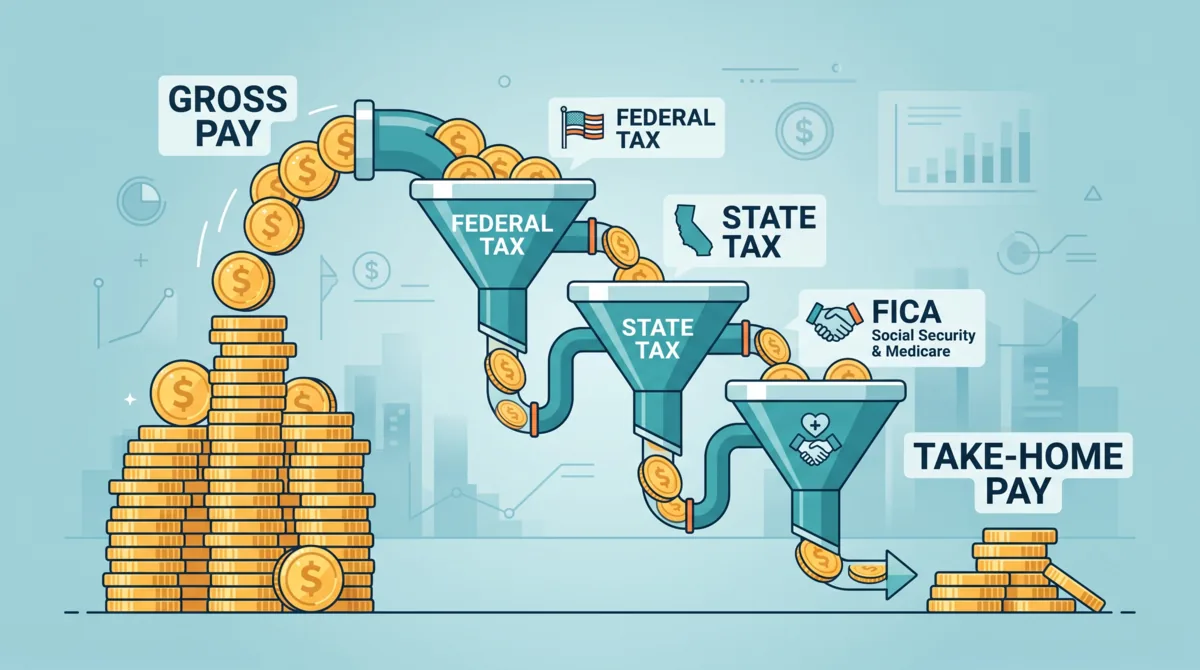
A job offer says $60,000 a year. Or maybe $25 an hour. Looks great, right?
But that number never hits your bank account. Not the full amount. Before you see a single dollar, taxes and deductions take their cut, and what's left over is your real pay.
This free take home pay calculator does that math for you. Punch in your salary or hourly rate, and it shows exactly what lands in your account after federal tax, state tax, FICA, 401(k), insurance, and everything else. It runs on the 2026 IRS tax brackets, so the numbers are current. Think of it as a net pay calculator and a take home calculator rolled into one. No guessing. No surprises on payday.
What Is Take-Home Pay?
Take-home pay is the money that actually reaches your pocket after every tax and deduction is pulled from your paycheck. That's it. The spendable stuff.
You'll hear it called other things too. Net pay. In-hand pay. Same idea, different names. If you searched for an in hand pay calculator, this is the tool you wanted.
The quick version of gross vs net? Your gross pay is the big headline number your boss promised you. Your net pay is what's left after the government and your benefits take their share. The gap between the two usually runs 20% to 30%.
How This Calculator Works (and Why We Built It)
Under the hood, this paycheck calculator net tool runs your income through the 2026 federal tax brackets (set by IRS Revenue Procedure 2025-32), then layers on Social Security, Medicare, your state and local taxes, and any deductions you enter. It does in one second what would take you twenty minutes and a calculator app.
Why did we build it? Because job offers and salary talk always use gross numbers, and gross numbers lie to you. Nobody hands you a clear answer to the real question: how much does taxes take out of your check?
So we made one. You get an honest, itemized breakdown instead of a vague "expect around 25% gone." Every figure here traces back to official 2026 IRS and Social Security Administration data, not a rough guess.
How to Use the Take-Home Pay Calculator
You don't need to be an accountant. The whole thing, start to finish:
- Pick your filing status. Single, Married Filing Jointly, Married Filing Separately, or Head of Household. This changes your brackets and your standard deduction, so get it right.
- Choose salary or hourly. Salaried folks enter an annual gross. Hourly workers enter their rate, weekly hours, and any overtime (paid at 1.5x).
- Set your pay frequency. Weekly, bi-weekly, semi-monthly, monthly, or annually.
- Add state and local tax. Enter your estimated percentages. Live in Texas or Florida? Enter 0 for state.
- Enter pre-tax deductions. Your 401(k) percentage, plus per-check health insurance and HSA/FSA amounts.
- Add dependents and withholding. Kids under 17, whether you're 65 or older, and any extra withholding from your W-4.
Hit calculate. Your true net pay shows up instantly, split line by line so you can see where every dollar went.
How to Calculate Take-Home Pay Manually
Want to check the math yourself? Good. Let's walk through how do I calculate take home pay by hand, no tool needed.
Picture a single person pulling in $120,000 a year in 2026. No 401(k) yet. Average state tax. Watch what happens to that number.
Start with gross pay. $120,000. That's the whole thing, before anyone touches it.
Then FICA takes its cut. Social Security grabs 6.2%, Medicare another 1.45%. Add those and you get 7.65%, or $9,180 gone. This one stings a little, because FICA comes off your full gross before any other tax math even begins.
Next comes the standard deduction. A single filer in 2026 gets $16,100 knocked off the top. So the income that actually gets taxed isn't $120k anymore. It drops to $103,900.
Now the federal brackets. Here's where people trip up. Federal tax is progressive. Each slice of your income is taxed at its own rate, not one flat rate on the whole pile. Run $103,900 through the 2026 brackets and a single filer owes roughly $17,400.
Last, state and local tax. Say you're at a 5% state rate. On this income, that's about $6,000.
Now add up the damage. Gross $120,000. Minus $9,180 for FICA. Minus about $17,400 federal. Minus about $6,000 state. Your 120k take home pay lands near $87,400 a year. Roughly $7,280 a month.
See what happened there? A $120,000 offer quietly turned into $87,400. The standard deduction and those brackets did most of the shaping, and you never even saw it happen on the offer letter.
Understanding Every Feature
This calculator has a field for nearly every real-world paycheck situation. What each one does, field by field.
Filing Status: Single, Married, or Head of Household
Your filing status decides two things: your tax brackets and your standard deduction. And no, they aren't the same across statuses.
A married filing jointly couple gets the widest brackets and a $32,200 standard deduction in 2026. A single filer? Just $16,100. Head of household lands in the middle at $24,150, with brackets wider than single. Pick the one that matches your real tax return. Get it wrong and every number below it is off too.
Salary vs Hourly (and How Overtime Is Taxed)
Salaried? Your check is the same every period. Hourly? It swings with your hours, and this paycheck calculator hourly mode handles overtime at 1.5x automatically.
Now, a myth worth killing. Does overtime get taxed more? No. Not really. Overtime is taxed at your normal rate. It only feels higher because a big week can make payroll software withhold more for that single check, and you usually get that back at tax time. See the exact math on our overtime pay calculator.
Pay Frequency: Weekly, Biweekly, Semi-Monthly, Monthly
This one trips people up. Biweekly means 26 checks a year. Semi-monthly means 24. Same yearly salary, different check sizes.
And here's the fun part. Biweekly folks get a third paycheck in two months of the year. Your frequency never changes your annual tax, though. It just slices it up differently. Compare both side by side with our semi-monthly vs biweekly calculator.
State and Local (City) Tax
Federal tax is the same everywhere. State and local tax is not, and that's where your take-home really swings.
Nine states take nothing from your wages. Others, like California or New York, take a real bite. Some cities pile their own tax on top of that. Since we don't grab your address, you enter your rate here. Check a recent pay stub if you're unsure.
401(k) Contributions
Here's where it gets good. Does a 401k lower my taxes? Yes, if it's a traditional 401(k). Your contribution comes out before income tax is calculated, which shrinks your taxable income.
So how does 401k affect take home pay? Less than you'd think. Put in $1,000 and your take-home only drops by around $730, because that money would've been taxed anyway. One catch, though. A 401(k) lowers your income tax, but not your FICA. Social Security and Medicare still apply.
Health Insurance, HSA, and FSA
These beat a 401(k) on taxes, and almost nobody tells you why. Does health insurance come out before taxes? Yes, when it's an employer plan.
But the real edge is this. Your health premiums, HSA, and FSA contributions lower both your income tax AND your FICA. A traditional 401(k) only skips income tax. So dollar for dollar, an HSA or FSA paycheck deduction saves you a bit more than the same amount parked in your 401(k).
Post-Tax Deductions
Some things come out after taxes are done. Union dues. Wage garnishments. Roth 401(k) money. None of these lower your tax bill. They just trim the cash you take home, so enter them here to keep your final number honest.
Dependents and the Child Tax Credit
Got kids? That helps. The 2026 child tax credit is $2,200 per qualifying child under 17, and it cuts your tax directly.
On your paycheck, it works through Step 3 of your W-4. Claim your kids there and your employer holds back less, so more money reaches you each payday instead of waiting for a refund in April.
Age 65 or Older
Turning 65 comes with a tax perk. You get a bigger standard deduction, an extra $2,050 if you're unmarried, or $1,650 per qualifying spouse if you're married. The calculator adds this for you when you flip the toggle.
Extra Withholding (W-4)
Want more tax held back on purpose? Some people do, just to dodge a bill in April. This is Step 4c on your W-4. Type a per-check dollar amount here, and the calculator pulls it out. Smaller check now, safer tax season later.
2026 Federal Tax Brackets by Filing Status
Federal tax is progressive, so different slices of your income are taxed at different rates. Here are the 2026 brackets for each filing status, per IRS Revenue Procedure 2025-32:
| Rate | Single | Married Filing Jointly | Head of Household |
|---|---|---|---|
| 10% | $0 – $12,400 | $0 – $24,800 | $0 – $17,700 |
| 12% | $12,400 – $50,400 | $24,800 – $100,800 | $17,700 – $67,450 |
| 22% | $50,400 – $105,700 | $100,800 – $211,400 | $67,450 – $105,700 |
| 24% | $105,700 – $201,775 | $211,400 – $403,550 | $105,700 – $201,775 |
| 32% | $201,775 – $256,225 | $403,550 – $512,450 | $201,775 – $256,225 |
| 35% | $256,225 – $640,600 | $512,450 – $768,700 | $256,225 – $640,600 |
| 37% | Over $640,600 | Over $768,700 | Over $640,600 |
Standard deduction for 2026: $16,100 (Single or Married Filing Separately), $32,200 (Married Filing Jointly), $24,150 (Head of Household). Filers 65 or older get an extra $2,050 (unmarried) or $1,650 (married, per qualifying spouse).
Take-Home Pay Examples by Salary
Numbers make it real. Here's what common salaries look like after taxes for a single filer in 2026, assuming an average 4% state tax and no major deductions.
So what is your take home pay on 100k? Around $75,000 a year. That's about $6,265 a month. Not the $8,333 you'd picture if you forgot taxes existed.
| Yearly Gross Salary | Estimated Yearly Net Pay | Estimated Monthly Net Pay |
|---|---|---|
| $30,000 | $25,085 | $2,090 |
| $50,000 | $40,355 | $3,363 |
| $75,000 | $58,593 | $4,883 |
| $100,000 | $75,180 | $6,265 |
| $120,000 | $87,400 | $7,280 |
| $150,000 | $107,791 | $8,983 |
Teachers, this works for you too. Enter your gross and drop your pension contribution into the deductions field, and it doubles as a teacher pay calculator take home breakdown. Your pension usually comes out pre-tax, which trims your taxable income a little.
One caveat. Your exact number moves with your state, your deductions, and your filing status. Treat these as ballpark figures, not promises. For the official rules behind these numbers, see the IRS 2026 inflation adjustments, the SSA wage base table, and the Department of Labor's overtime rules. Want to see your annual number sliced into an hourly rate instead? Try our salary to hourly calculator, or run your everyday spending through the 50/30/20 budget calculator once you know your real take-home number.
Frequently Asked Questions
How much is take-home pay on $100k?
Around $75,000 a year for a single filer in 2026. That works out to about $6,265 a month with an average state tax. Live in a no-income-tax state and you'll keep closer to $78,000. A 401(k) or other deductions will shift it again.
How much is take-home pay on $120k?
A single filer on $120,000 takes home roughly $87,400 a year, or about $7,280 a month, with an average state tax. No income tax where you live? You keep more. Toss in a 401(k) and your taxable income drops, which nudges the number too.
How does a 401(k) affect my paycheck?
Less than you'd expect. A traditional 401(k) lowers your take-home by less than you actually contribute, since that money would have been taxed anyway. It trims your income tax but not your Social Security and Medicare. Small hit now, bigger balance later.
Does health insurance come out before taxes?
Usually, yes. Employer health premiums come out pre-tax, and that lowers both your income tax and your FICA. It's what makes health insurance, HSA, and FSA some of the most tax-friendly deductions on your whole check.
How does the child tax credit affect my paycheck?
Each qualifying child under 17 is worth $2,200 in 2026. Claim your kids on Step 3 of your W-4 and your employer withholds less, so your take-home climbs during the year instead of showing up as one big refund in spring.
What is in-hand pay?
Just another name for take-home pay or net pay. It's the cash left after every tax and deduction, the amount that actually reaches your hand. That's the exact number this calculator spits out.
Does overtime get taxed more?
No. Overtime is taxed at the same rate as your regular pay. A big overtime week can make payroll withhold more for that one check, but it evens out when you file. Any extra usually comes back to you as a refund.
Watch: Gross Pay vs Net Pay Explained
Prefer video? This quick 4-minute breakdown from payroll company OnPay covers the same gross-to-net basics this calculator runs on.
All calculations use 2026 IRS tax brackets (Rev. Proc. 2025-32), the $184,500 Social Security wage base, and current Department of Labor guidance. This tool gives estimates for planning and does not replace professional tax advice.