Reverse Auto Loan Calculator
Calculate How Much Car You Can Afford Based on a Monthly Payment
Last updated: August 2026
Reverse Auto Loan Calculator: How Much Car Can You Actually Afford?
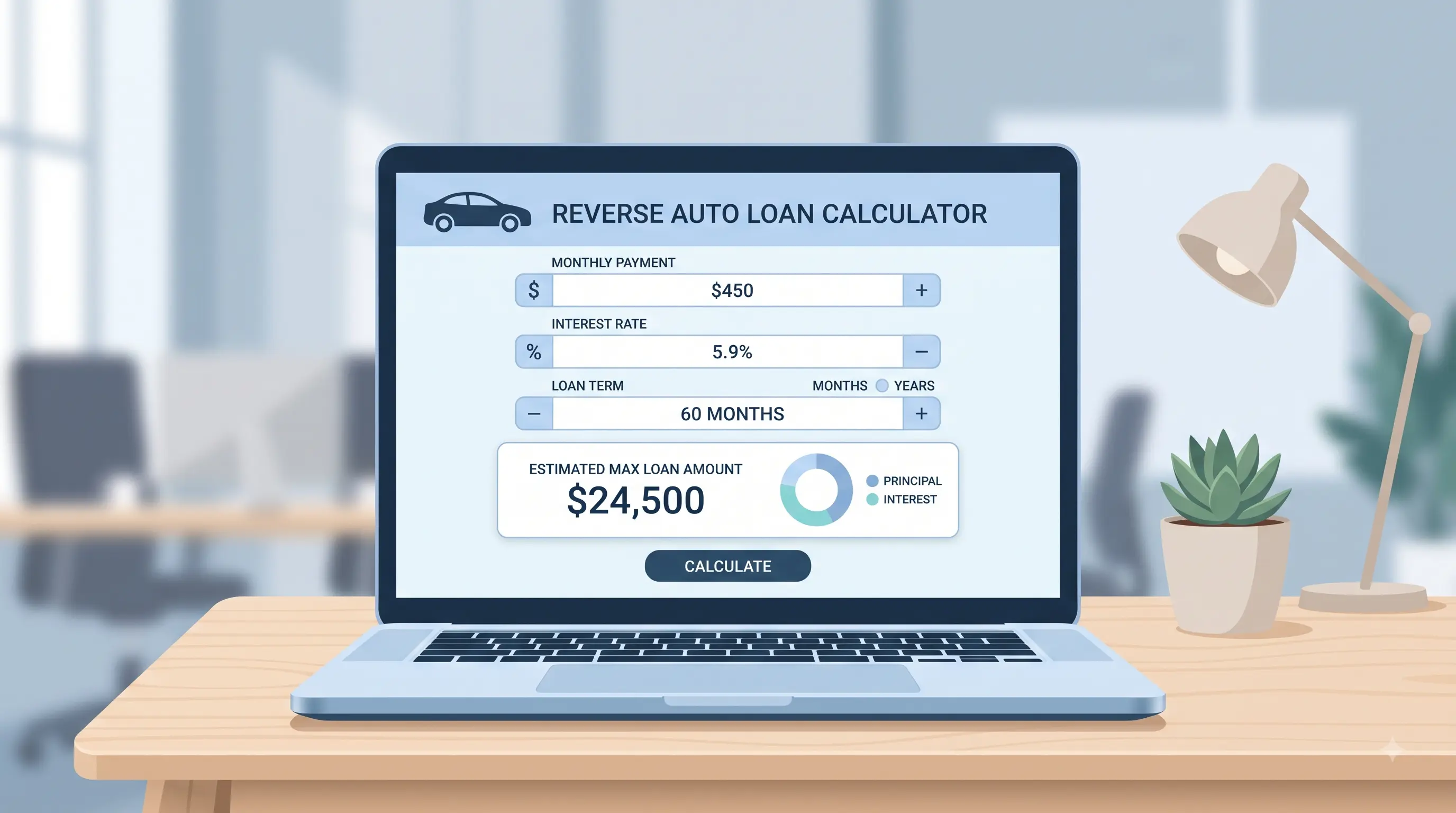
Car salesmen love one question: “How much can you afford per month?” The math begins to work against you the moment you sign on the dotted line – the interest rate slowly creeps up, the loan term lengthens from 60 to 72 or even 84 months and a few “dealer fees” are thrown in. Before you know it, that “affordable” $450 a month payment is really paying for a car that’s worth thousands more than you would have agreed to had you seen the real price tag up front.
That’s the problem a reverse car loan calculator is intended to solve. This is the reverse of the usual process of figuring out how much car you can afford to buy. Instead, it says, here’s the payment you can comfortably make, and here’s the maximum loan amount — and maximum car price — that payment can support.
What Is a Reverse Auto Loan Calculator?
A standard auto loan calculator works like this:
Loan Amount → Interest Rate → Loan Term → Monthly Payment
A reverse auto loan calculator works backward:
Monthly Payment → Interest Rate → Loan Term → Maximum Loan Amount
It’s built for how most people really budget for a car. Most buyers don't start by saying, "I want to finance $28,000." Most people start with “I can afford $400 a month” and that is exactly the number a reverse calculator is geared to work with.
How to Use This Reverse Auto Loan Calculator
Our free reverse auto loan calculator uses eight simple inputs to give you an accurate, realistic buying range — no sign-up required, and every calculation happens locally in your browser:
- Target Monthly Payment ($) — The amount you're realistically comfortable paying every month, based on your actual budget.
- Annual Interest Rate (%) — The APR you expect or have been quoted. This should reflect your credit tier, not a guess.
- Loan Term — Choose from 36, 48, 60 (the most common default), 72, or 84 months.
- Down Payment ($) — Cash you're putting down upfront.
- Trade-In Value ($) — The estimated value of your current vehicle, if trading in.
- Amount Owed on Trade-In ($) — Any remaining loan balance on that trade-in vehicle.
- Sales Tax Rate (%) — Your local tax rate, since it affects the true out-the-door price.
- Dealer Fees & Other Charges ($) — Documentation fees, registration, and other add-ons.
Once you hit Calculate, the tool instantly returns three numbers: your Maximum Loan Amount, your Total Down Payment / Equity, and — most importantly — your Max Car Purchase Price. You can then print, copy, or download the results to take with you to the dealership.
The Reverse Loan Calculation Formula: How the Math Really Works
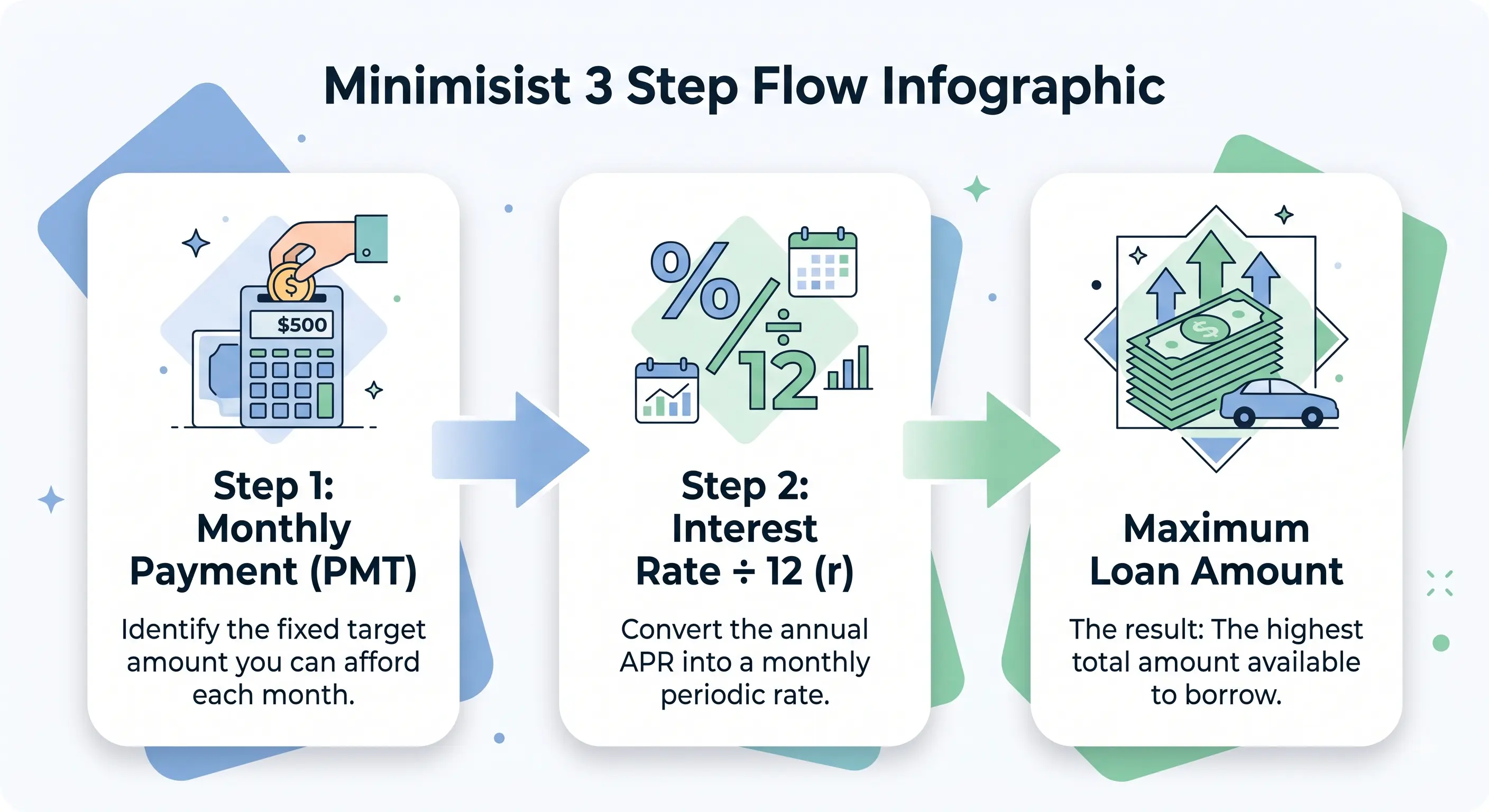
The reverse loan calculation helps you find how much you can borrow based on the monthly payment you can afford. Instead of calculating the EMI from a known loan amount, it works backward from the payment to estimate the loan principal.
The Reverse Loan Formula
Loan Amount = Monthly Payment × [1 − (1 + Monthly Rate)−n] ÷ Monthly Rate
Where:
- Monthly Payment = Your monthly loan payment
- Monthly Rate = Annual interest rate ÷ 12 ÷ 100
- n = Loan term in years × 12
Example
Suppose you are considering a car loan with:
- Monthly payment = $500
- Annual interest rate = 7.0%
- Loan term = 5 years (60 months)
First, calculate the monthly interest rate:
Monthly Rate = 7.0 ÷ 12 ÷ 100 = 0.0058333
Now calculate the total number of payments:
n = 5 × 12 = 60
Then:
Loan Amount = $500 × [1 − (1 + 0.0058333)−60] ÷ 0.0058333 ≈ $25,251.00
So, a $500 monthly payment at 7% interest for 5 years corresponds to a loan of approximately $25,251.
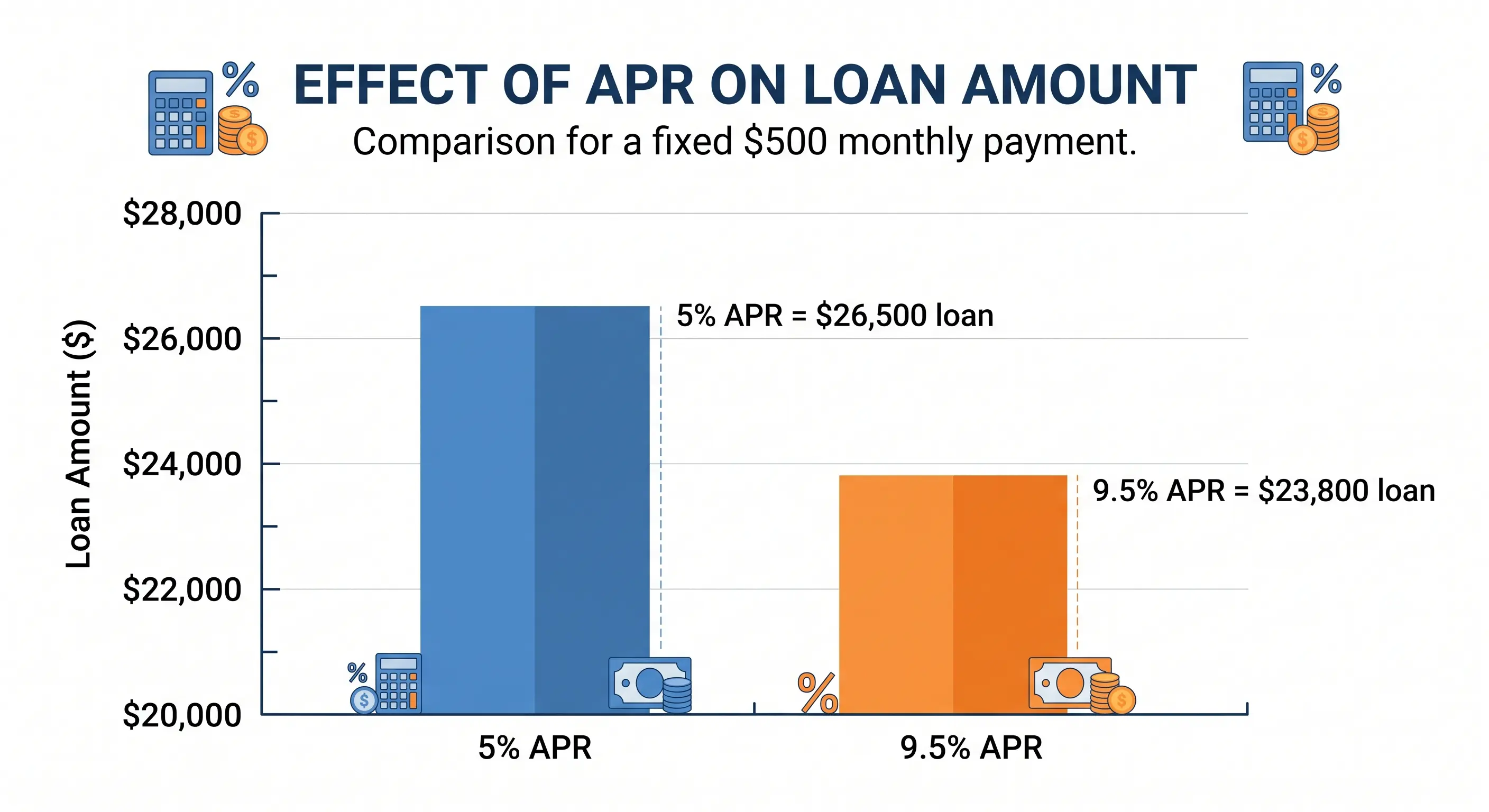
Same monthly payment, different loan amount — the interest rate makes a real difference.
Comparing Loan Terms: 60 vs. 72 vs. 84 Months
Choosing the best loan term for a car isn't just about the lowest monthly payment — it's about total cost. Here's roughly how the same $25,000 loan at 7% APR plays out across different terms:
| Loan Term | Approx. Monthly Payment | Total Interest Paid |
|---|---|---|
| 60 Months (5 Years) | ~$680 | $3,500 |
| 72 Months (6 Years) | ~$560 | $7,500 |
| 84 Months (7 Years) | ~$490 | $12,000 |
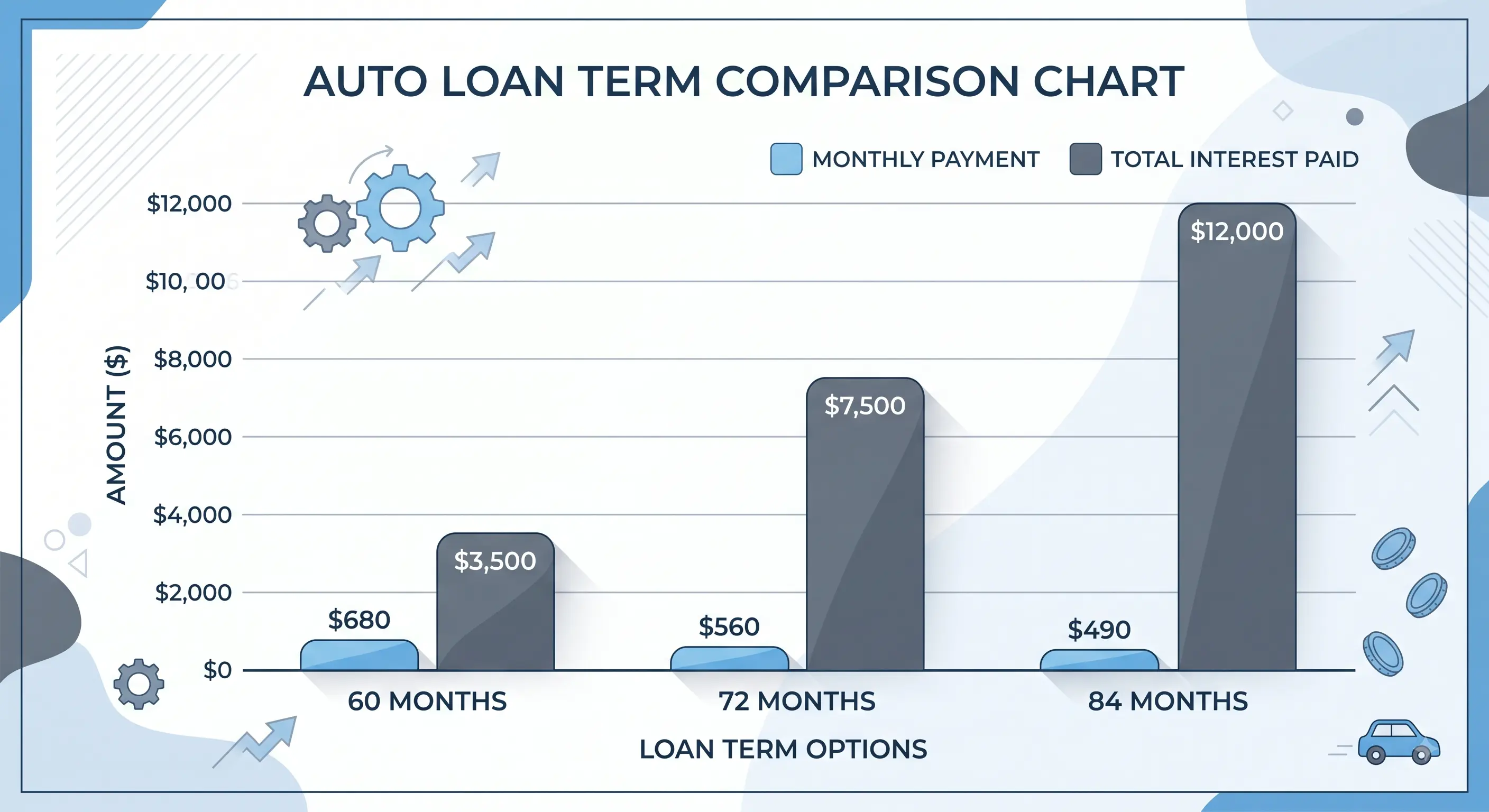
Longer terms lower your payment but raise your total interest cost.
A longer term lowers your monthly payment, but it also means you're paying interest longer — and you spend more time "underwater," owing more than the car is worth. If minimizing total cost is your goal, shorter terms almost always win. Longer terms help, of course, if you want to protect your cash flow each month, but it should be a conscious decision, not something a salesperson quietly tacks on without you noticing.
Why Dealers Favor Monthly Payment Over Price
Here’s what you should know before you walk into a showroom. If a dealer sticks to the “what monthly payment works for you” it’s not because they’re trying to save you money. It’s because it’s much easier to manipulate a monthly number than a sticker price. They may also keep your payment in your comfort zone by increasing the interest rate a little, lengthening the term, or “packing” the payment with extras like extended warranties or gap insurance, all of which increase what you actually finance.
A reverse auto loan calculator turns that leverage back to you. Walking in knowing your maximum loan amount and maximum car price means you're negotiating from the actual number that matters — the price of the vehicle — rather than a payment that can be stretched out quietly.
Factors affecting your result
- Credit Score: Your interest rate will be directly based on your credit history. In general, higher score = lower rate, meaning more loan amount for the same monthly payment.
- Loan Term: The longer the term the lower the monthly payment but the higher the total interest paid. A shorter time does the opposite.
- Down Payment: The more you can put down, the less you have to finance, either lowering your payment or allowing you to purchase a more expensive vehicle for the same payment.
- Trade-in equity: When your trade-in is worth more than what you owe, the difference is additional buying power. If you’re under the water, that difference is working against you.
- Sales Tax & Fees: This varies by state and dealership and will directly reduce your maximum purchase price if not accounted for up front.
Before you borrow, understand the full financial picture
While a reverse auto loan calculator will tell you what one loan can afford, a smart car purchase needs to fit into your entire financial picture, not just one payment in isolation.
Take a look at your debt-to-income ratio before you write a check for a monthly car payment. Lenders use front-end DTI and back-end DTI to assess not only if you qualify for a loan but how much they’re willing to loan — a new car payment added to existing debt can push your DTI into risky territory, even if the reverse calculator says you can “afford” it.
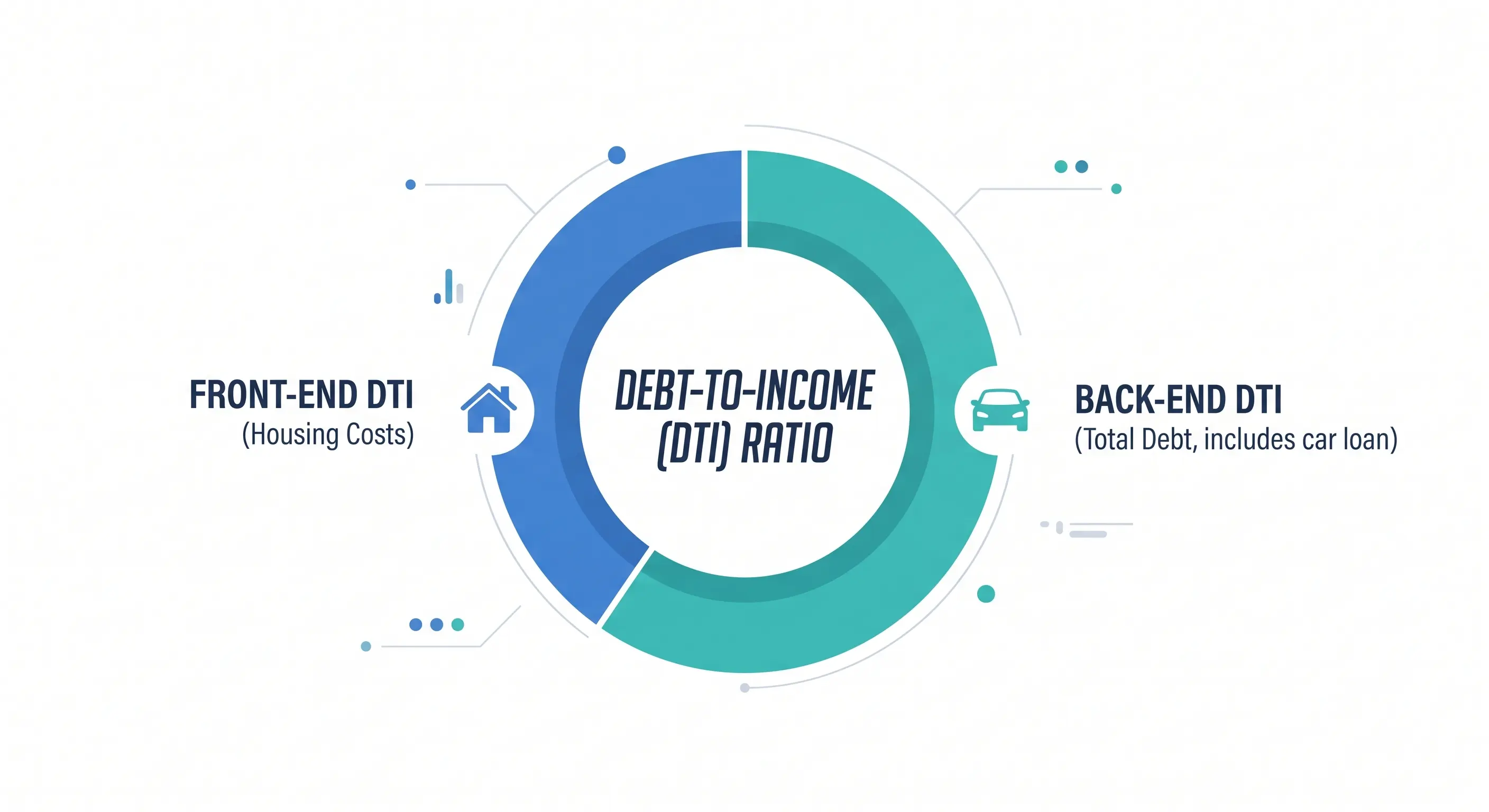
If you’re already in debt, whether it’s credit cards, student loans, or personal loans, do yourself a favor and run the numbers through a debt payoff calculator first. Choosing between a snowball vs. avalanche repayment strategy can help you decide if it makes sense to pay off some of your existing debt before taking on a new auto loan, which can affect your DTI and interest rate offer.
Tips for Getting the Most Out of This Calculator
- First, check your credit score. Knowing your true credit tier means you can input an accurate interest rate rather than guessing, and guessing can skew your maximum loan amount by thousands.
- Get pre-approved before you visit the dealership. Preapproval from a bank or credit union gives you real negotiating power and protects you from inflated dealer-arranged rates.
- Don't forget taxes and fees. They can make a real difference to your actual purchase price so always factor them in and don't just work on price alone.
- See loan terms side-by-side. A longer-term loan with a lower payment could cost thousands in interest. Run both scenarios before you make a decision.
- Be sure to check your DTI before committing. A car payment that seems okay on its own can add up when you add in your other financial obligations.
Common Questions
How much car loan can I get for 500 a month?
It is contingent upon your interest rate and term. 5% APR for 60 months - roughly $26,500. 9.5% APR for 60 months - approximately $23,800.
What's a good car payment a month?
Most financial guidelines recommend keeping your total auto costs, including insurance, under 15-20% of your take-home pay. Looking at your debt-to-income ratio can give you a more personalized answer.
What is the effect of trade-in value on my car loan?
Positive trade-in equity (you owe less than the vehicle is worth) increases your buying power. Negative equity makes it smaller as the gap is rolled into your new loan.
Is a longer loan term a bad idea?
Not always — can make sense for cash flow — but it almost always means paying more total interest, so it should be a conscious choice, not a default.
Concluding Thoughts
A reverse auto loan calculator makes car shopping less of a guessing game and more of a plan. You walk in knowing your maximum loan amount, realistic purchase price and how your credit score and loan term choices affect both, instead of letting a dealer define your budget with a monthly number. Add that to a quick glance at your debt-to-income ratio and, if needed, a debt payoff plan, and you'll know exactly what you can — and can't — afford before anyone tries to talk you into more.
Frequently Asked Questions
What is a reverse auto loan calculation?
A reverse auto loan calculation works backward from your budget. Instead of finding your monthly payment from a car's purchase price, you enter your target monthly payment to find the maximum car price you can afford to buy.
How is the maximum loan amount calculated?
It uses the standard loan amortization formula solved for principal: Principal = PMT × (1 − (1 + r)−n) / r, where PMT is the monthly payment, r is the monthly interest rate, and n is the total number of months.
Should I include sales tax in my calculations?
Yes. If sales tax is applicable, it increases the total cost of the vehicle. Our calculator allows you to enter your local sales tax rate so it can estimate the actual sticker price of the car before taxes.
How much car can I afford for $400 a month?
At a 7% APR, a $400 monthly payment supports a loan of about $20,200 over 60 months, or about $23,500 over 72 months. Add your down payment and trade-in value to that, then subtract taxes and fees, to find the car price you can afford. Enter your own rate and term above for an exact answer.
How does a trade-in change how much car I can afford?
Your trade-in value works like an extra down payment. If your car is worth $5,000 and you owe nothing on it, you can buy a car $5,000 more expensive for the same monthly payment. If you still owe money on it, subtract the payoff amount first, because any negative equity gets rolled into your new loan.
How much car loan can I afford based on my income?
One popular guideline, the 20/4/10 rule, suggests putting 20% down, financing for no more than 4 years, and keeping total car costs under 10% of your gross monthly income. Lenders also look at your overall debt-to-income ratio, which you can check with our DTI Calculator.