APR to APY Calculator
Convert Between Nominal and Effective Interest Rates
Last updated: September 2026 • 100% private, runs entirely in your browser • no sign-up, no ads
Compounding Frequency Comparison
How the same APR turns into a different APY depending on how often it compounds. Your selected frequency is highlighted.
| Compounding | Periods / Year | Resulting APY |
|---|
Banks love showing you APY on a savings account. It's the bigger number, so it looks great. Lenders love quoting APR on a loan, because it's the smaller one.
Same underlying math. Different spin.
This free apr to apy calculator cuts through the marketing and shows you the real rate. Enter an APR and get the APY, or go the other way with apy to apr. Pick any compounding frequency, from daily to continuous, and see the true number in a second. No ads, no signup, nothing leaves your browser.
What Is the Difference Between APR and APY?
The short version: APR is what you pay to borrow, and APY is what you earn once compounding is counted. That single word, compounding, is the whole difference.
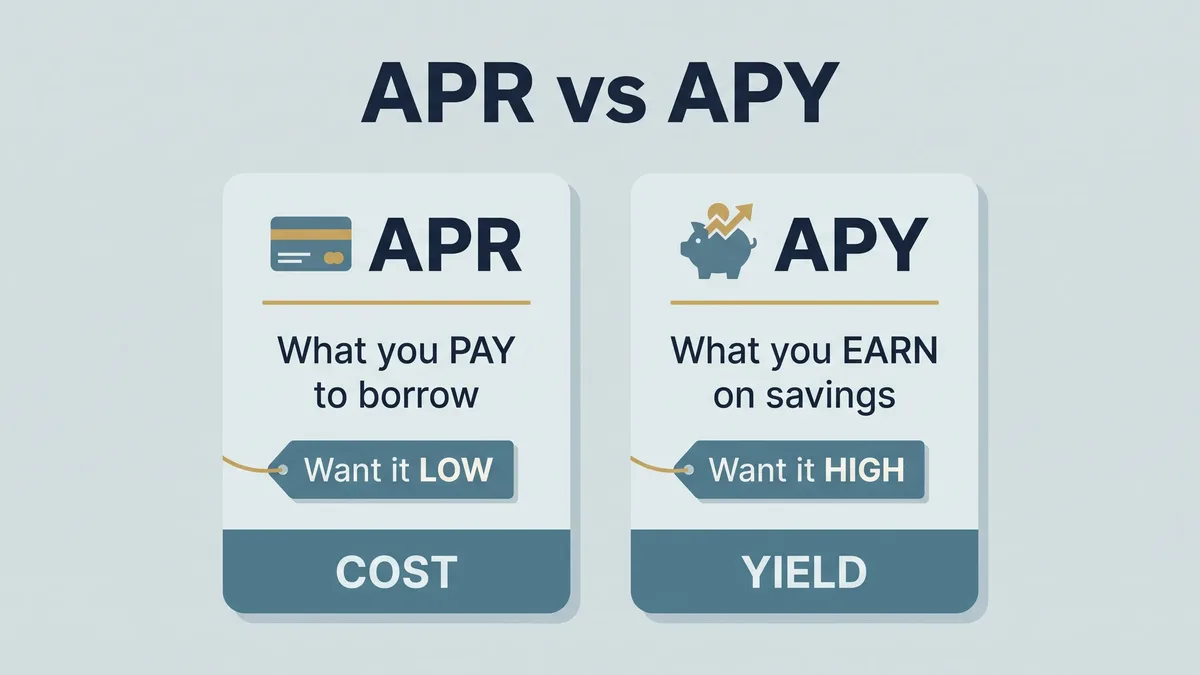
APR stands for Annual Percentage Rate. It's the simple, stated rate with no compounding baked in. You'll see it on loans, mortgages, and credit cards. It's a cost, so you want it low.
APY stands for Annual Percentage Yield. It folds in compounding, which means interest earning interest. You'll see it on savings accounts and CDs. It's a yield, so you want it high.
Here's the memory trick. APR is a cost, APY is a yield. When you understand the apr and apy difference, you stop getting fooled by whichever number a bank or lender decides to put in big font.
How to Use This APR to APY Calculator
It takes about ten seconds.
- Pick your direction. APR to APY, or APY to APR.
- Enter your rate. Type the percentage you already know.
- Choose the compounding frequency. Daily, monthly, quarterly, yearly, or continuous.
- Read your result. The converted rate appears instantly, along with a table showing every frequency.
Want a shortcut? Tap a quick-example button like "Credit card 24%" or "Savings 4.5%" to load real-world numbers and see how they convert apr to apy right away.
APR to APY Formula
Here's the math behind the tool. The formula to convert apr to apy is:
APY = (1 + APR/n)^n − 1
Don't panic. APR is your rate as a decimal, and n is how many times a year interest compounds. That's it.
Let's run one. Take a 12% APR compounded monthly, so n is 12. Plug it in and you get an APY of 12.68%. Same starting rate, but compounding pushed the real number higher.
Now the one that stings. A credit card at 24% APR, compounded monthly, actually works out to about 26.82% APY if you carry a balance. You're paying more than the sticker rate.
For continuous compounding, the apr to apy formula shifts slightly to APY = e^APR − 1, where e is roughly 2.718.
Going the other way? The tool reverses it too, turning an APY back into its nominal APR. This is the same thing finance folks call the effective annual rate calculator.
How Compounding Frequency Changes Your APY
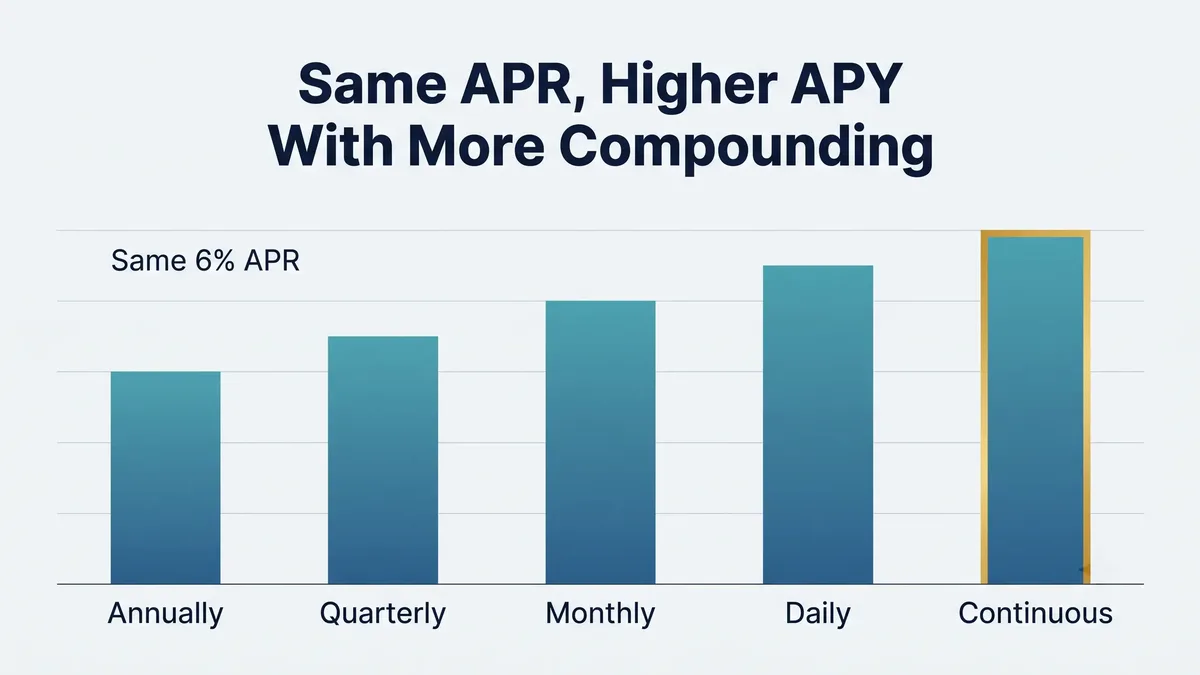
More frequent compounding means a higher APY, even when the APR stays exactly the same. That's the part most people miss.
Think about it. If interest is added daily instead of once a year, you start earning interest on that interest sooner. The gaps add up.
Take a 6% APR. Compounded once a year, the APY is just 6.00%. Compound it daily and it climbs to about 6.18%. Same 6% on paper, different real result. That's why is apy higher than apr in almost every case, and why the tool shows you a full comparison table across every frequency.
APR vs APY on Credit Cards and Savings
This is where the two terms trip people up the most.
Credit cards quote an APR. But interest usually compounds daily, so the real cost creeps above the stated rate. So when people ask do credit cards use apr or apy, the honest answer is they advertise APR, but you feel something closer to APY if you carry a balance.
Savings accounts and CDs quote an APY, which already includes compounding. That's the real return you take home.
The numbers tell the story. The average credit card APR hit 20.97% in late 2025 (Federal Reserve), while the average savings account paid just 0.39% APY in early 2026 (FDIC). Lenders and banks each show you the number that flatters them.
What the Difference Looks Like in Real Dollars
Percentages feel abstract, so let's put money on it. The calculator lets you enter a balance to see the gap in real dollars.
Say you park $10,000 in a savings account at a 5% rate. At simple interest with no compounding, you'd earn $500 in a year. Compounded daily, that same 5% turns into about 5.13% APY, which is roughly $513. A small gap, sure, but it grows with bigger balances and longer time frames.
Now flip it to debt. Carry a $10,000 balance on a card at 22% APR compounded daily, and the effective cost climbs past 24.6% APY. That extra chunk is money you never agreed to on the sticker rate, quietly stacked on by compounding. Seeing it in dollars is what makes the difference finally click.
Which Is Better, APR or APY?
Neither is "better." It depends which side of the deal you're on.
If you're borrowing, you want the APR low. If you're saving, you want the APY high. That's the whole rule. When people ask is apr or apy better, the real answer is to always compare like for like: APR against APR for loans, APY against APY for savings. Mixing them is exactly the trap that costs people money. Here's a quick way to keep it straight. Any time you see a rate, ask one question: is this money leaving me or coming to me? If it's leaving you (a loan, a card, a mortgage), that's APR territory, and lower wins. If it's coming to you (savings, a CD, a money market), that's APY territory, and higher wins. Get in the habit of asking that, and the two terms stop being confusing for good.
Watch: APR vs APY Explained
Prefer video? This explainer from Investopedia covers the same APR vs APY concepts this calculator is built on.
Frequently Asked Questions
What is the difference between APR and APY?
APR is the simple annual rate you pay to borrow, with no compounding. APY is the rate you earn on savings once compounding is included. APR is a cost you want low, and APY is a yield you want high. The gap between them is entirely due to compounding.
Is APY higher than APR?
Yes, whenever interest compounds more than once a year. APY includes the effect of interest earning interest, so it ends up equal to or higher than the APR. The more often it compounds, the bigger the gap.
Is APR the same as the interest rate?
Not quite. The interest rate is just the cost of borrowing the money. APR includes the interest rate plus certain fees, like some loan or mortgage charges, so it often runs a little higher than the plain interest rate.
Do credit cards use APR or APY?
Credit cards advertise an APR. But since the interest usually compounds daily, the real cost you pay when carrying a balance is closer to the APY. That's why a 24% APR card can effectively cost you nearly 27%.
How do you convert APR to APY?
Use the formula APY = (1 + APR/n)^n − 1, where n is the number of compounding periods per year. Or just enter your APR and compounding frequency into the calculator above and get the answer instantly.
What is a good APY on a savings account?
It changes with the market, but high-yield savings accounts usually pay far more than the national average, which was around 0.39% in early 2026. Always compare APY to APY across accounts, since that number already includes compounding.
Why is APY higher than APR?
Because APY counts compounding and APR does not. When your interest earns its own interest through the year, the effective yearly rate rises above the simple stated rate. Faster compounding widens the gap.
The Bottom Line
APR and APY aren't tricks, but they are easy to mix up, and that confusion usually costs you. Learn which one you're looking at, convert it when you need to compare, and you'll never get fooled by a flattering number again.
For more, try our Loan Amortization Calculator to see interest over a full loan, or the Take-Home Pay Calculator for your real paycheck.
This calculator provides estimates for planning and education. Always confirm the exact APR or APY with your bank or lender's disclosure documents.