Semi-Monthly vs Biweekly Pay Calculator
Compare paycheck frequencies and calculate gross earnings side-by-side
Last updated: July 2026
Paycheck Comparison Results
Payroll Comparison Summary
Deciding between a biweekly and semi-monthly payroll schedule can be confusing. While both options distribute the same annual salary, they affect paycheck amounts and pay cycle frequencies differently. For employees, the schedule determines how they manage budgets, pay bills, and allocate savings. For employers, the choice impacts payroll administration, overtime compliance under the FLSA, and accounting periods.
This free online calculator lets you compare paycheck sizes side-by-side using either an annual salary or an hourly wage. Find out exactly how much you will receive per paycheck and map out your three-paycheck months.
Semi-Monthly vs Biweekly Pay: Compare Your Paycheck in Seconds
You see a job offer with a $60,000 annual salary.
Then you look at the payroll schedule and notice it says biweekly.
Another employer offers the same $60,000 salary but pays semi-monthly.
At first glance, the 2 offers can look different because the paycheck amounts are different. The salary, however, can be exactly the same.
That's because semi-monthly and biweekly pay divide your annual income in different ways.
A semi-monthly schedule normally has 24 pay periods per year, while a biweekly schedule usually has 26. The IRS uses those same annual-period counts in its 2026 federal withholding tables.
This guide shows exactly how the 2 schedules work, why your paycheck changes, and how to compare them with a Semi-Monthly vs Biweekly Pay Calculator.
The Difference in One Table
| Comparison Metric | Semi-Monthly | Biweekly |
|---|---|---|
| Pay schedule | 2 times per month | Every 2 weeks |
| Typical pay periods | 24/year | 26/year |
| Paychecks in most months | 2 | 2 |
| 3-paycheck months | No | Possible (2 months/year) |
| Basic gross-pay calculation | Salary ÷ 24 | Salary ÷ 26 |
| Company use | Salaried payroll | Salaried and hourly payroll |
The key distinction is simple: semi-monthly follows the calendar month, while biweekly follows a 14-day cycle.
ADP describes semimonthly payroll as 24 pay periods and biweekly payroll as 26, with some calendar years producing 27 biweekly periods depending on the payroll calendar.
Semi-Monthly vs Biweekly: What Do These Terms Actually Mean?
The words sound almost identical, which is why payroll terminology causes so much confusion.
Semi-Monthly Pay
Semi-monthly means you're paid 2 times each month.
That normally gives you:
An employer might schedule payments around the 15th and last day of the month, although exact dates vary by company and payroll policy. Pay dates can also shift when weekends or holidays affect the normal schedule.
The biggest advantage is predictability. You know there will generally be 2 paychecks in every calendar month.
Biweekly Pay
Biweekly means you're paid every 2 weeks.
A year contains 52 weeks, so the normal calculation is:
Because a 14-day cycle doesn't fit perfectly into calendar months, some months can have 3 paydays instead of 2. ADP and Paychex both note that certain calendar years can produce 27 biweekly pay periods depending on the employer's exact payroll schedule.
That difference is the reason a biweekly paycheck calendar can look unusual when compared with a monthly calendar.
How Much Will I Get Paid?
This is where the calculator becomes useful.
Suppose your annual salary is: $60,000
For a basic gross-pay comparison, divide that salary by the number of annual pay periods.
Semi-Monthly Calculation
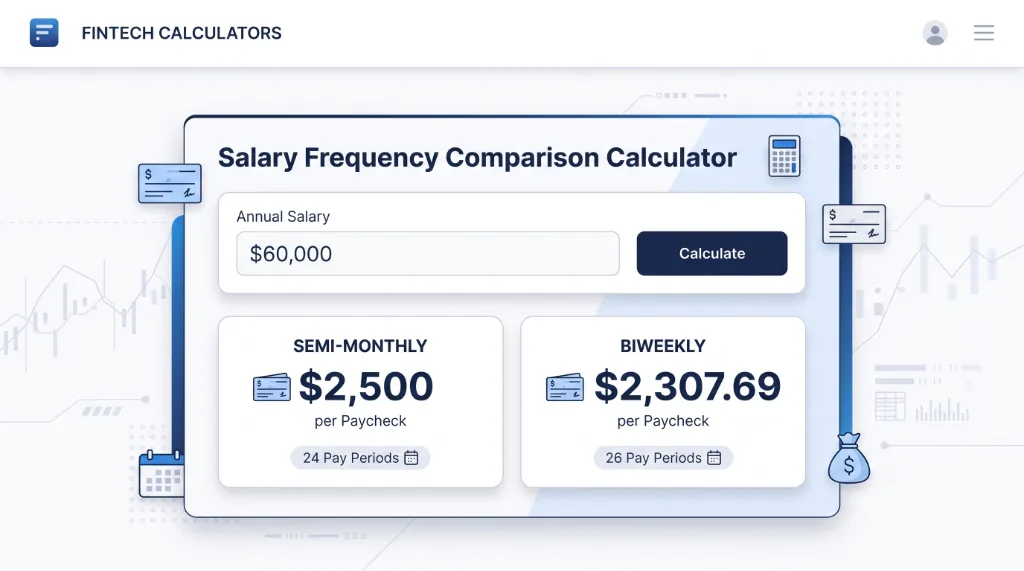
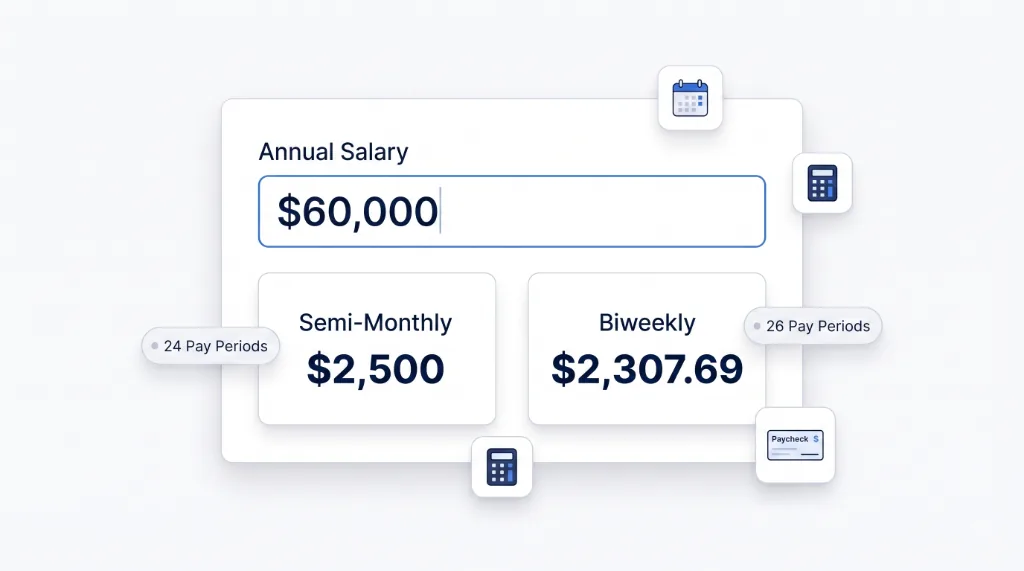
$60,000 ÷ 24 = $2,500
Your estimated gross semi-monthly paycheck is: $2,500
Biweekly Calculation
$60,000 ÷ 26 = $2,307.69
Your estimated gross biweekly paycheck is: $2,307.69
So the individual semi-monthly paycheck is about: $192.31 higher
But that doesn't mean the semi-monthly employee earns more. Both examples started with the same $60,000 annual salary. The money is simply distributed across a different number of paychecks. If you want to translate this yearly income to hourly terms, check out our Salary to Hourly Calculator.
Use the Semi-Monthly vs Biweekly Pay Calculator
Doing one calculation on paper takes less than a minute. Comparing several salaries, however, gets annoying quickly. That's exactly where our Semi-Monthly vs Biweekly Pay Calculator can help.
Enter your annual salary or hourly rate, and use the calculator to compare the estimated gross amount under 24 semi-monthly pay periods versus 26 biweekly pay periods side-by-side.
How to Use the Calculator
- 1. Enter your annual salary: Use your gross yearly salary before taxes and other payroll deductions.
- 2. Run the comparison: The calculator applies the standard 24-period and 26-period calculations instantly.
- 3. Check the paycheck estimates: You'll see the estimated semi-monthly and biweekly gross amounts.
- 4. Compare the difference: This shows how much larger or smaller one regular paycheck is under each schedule.
- 5. Use the numbers for planning: The result can help when you're comparing job offers, organizing a budget, or trying to understand your payroll schedule.
The calculation itself is simple. The benefit is having both results in one place instead of calculating them separately.
$50,000 Salary: Semi-Monthly vs Biweekly
Let's use another example. Suppose your annual salary is $50,000.
Semi-Monthly
$50,000 ÷ 24 = $2,083.33
Estimated gross paycheck: $2,083.33
Biweekly
$50,000 ÷ 26 = $1,923.08
Estimated gross paycheck: $1,923.08
Difference
$2,083.33 − $1,923.08 = $160.25
The semi-monthly paycheck looks larger by about $160.25. Yet the annual salary remains $50,000. This is why looking only at one paycheck can give you the wrong impression when comparing payroll schedules.
Why Is the Semi-Monthly Paycheck Bigger?
There is a simple mathematical reason. You're dividing the same annual salary by 2 different numbers.
With semi-monthly pay: Annual salary ÷ 24
With biweekly pay: Annual salary ÷ 26
Because 24 is smaller than 26, dividing by 24 produces a larger individual payment.
Think of your annual salary as one large amount of money. With a semi-monthly schedule, it's split into 24 pieces. With a biweekly schedule, it's usually split into 26 pieces. The pieces are different sizes, but the underlying annual salary remains the same.
Does Biweekly Pay Mean You Make More Money?
No, not by itself. A payroll frequency does not automatically increase your annual salary. Suppose two employees each earn $60,000. One is paid semi-monthly, and the other is paid biweekly. Their regular gross paycheck estimates are:
| Salary | Semi-Monthly | Biweekly |
|---|---|---|
| $60,000 | $2,500.00 | $2,307.69 |
The biweekly employee receives more regular paydays in a typical year, but each regular paycheck is smaller. The total compensation should be evaluated using the annual salary and the actual employment terms, rather than the size of one paycheck.
Why Do Biweekly Employees Sometimes Get 3 Paychecks in a Month?
This is one of the biggest differences you'll notice when looking at a real payroll calendar. Imagine you're paid every other Friday. Your paydays might fall like this:
Friday → 14 days → Friday → 14 days → Friday
If those 3 dates happen to fall inside the same calendar month, you'll have a 3-paycheck month. This doesn't happen every month; it happens because a 14-day schedule moves independently of the beginning and ending dates of calendar months.
Paychex notes that some biweekly payroll calendars can have months with 3 pay periods and recommends reviewing the payroll calendar in advance for planning purposes. For someone creating a household budget, these months can be extremely useful. A third paycheck can be assigned to a savings goal, a planned large expense, or another financial priority rather than being treated as ordinary monthly income.
What About 27 Paychecks?
Here's an important detail: 26 is the normal biweekly calculation, but some payroll calendars have 27 pay periods in a calendar year. The reason is the calendar itself. A year is slightly longer than exactly 52 weeks, and the employer's specific pay dates determine how those extra days line up over time.
ADP confirms that some years can have 27 biweekly pay periods. So don't assume that every employer will have exactly 26 paychecks in every calendar year. The safest approach is to check your company's actual payroll calendar.
Does 27 Paychecks Mean Extra Annual Salary?
Not necessarily. This is an area where a simple calculator can be misleading if you don't understand the employer's payroll policy. For hourly employees, actual annual earnings can depend on the hours worked and pay rate (you can compute your annual equivalent using our Hourly to Salary Calculator). For salaried employees, employers may structure payroll differently when a calendar contains 27 pay periods. The salary may be spread across the scheduled payments or otherwise handled according to the employer's payroll setup.
So if you see a 27-pay-period year, don't automatically assume you're getting an extra full year's salary on top of your contracted compensation. Check the employer's payroll documentation.
Semi-Monthly vs Biweekly for Monthly Budgeting
The best schedule for your budget depends on how your expenses are organized.
Semi-Monthly Can Feel More Predictable
If most of your bills are monthly, 2 paychecks every month can make the calendar easy to follow. You receive:
Paycheck 1 + Paycheck 2 = monthly pay flow
There isn't usually a third paycheck to plan around.
Biweekly Can Give You More Frequent Cash Flow
With biweekly pay, money arrives every 2 weeks. Most months still contain 2 paydays, but certain months can contain a third payday. That can be helpful when you build a budget around a regular 14-day cycle. Neither schedule is automatically better. The important part is knowing when the money arrives and how much each paycheck contains ahead of time.
Gross Pay vs Take-Home Pay
One important warning: the calculations above show gross pay, not your actual bank deposit. Your net income can be estimated using our Take-Home Pay Calculator, which accounts for factors such as:
- Federal income tax withholding
- State and local taxes
- Social Security and Medicare taxes
- Health insurance premiums
- Retirement contributions
- Other payroll deductions
The IRS has separate 2026 withholding calculations for semimonthly and biweekly payroll periods, which shows why tax withholding can't simply be treated as a fixed percentage of every paycheck. So if your calculator shows $2,500, that doesn't necessarily mean $2,500 will reach your bank account. It is an estimate of gross pay before deductions.
Which Pay Schedule Is Better?
There isn't one universal winner.
Semi-monthly may suit you better when: Your bills are strongly tied to monthly dates and you prefer exactly 2 paychecks in each month.
Biweekly may suit you better when: You prefer a consistent 2-week payment cycle and want to plan around occasional 3-paycheck months.
But when comparing 2 jobs, payroll frequency shouldn't be the only thing you look at. Compare: Annual salary + benefits + deductions + pay dates + hours + overtime rules + payroll schedule. The paycheck frequency is only one part of the compensation picture.
Semi-Monthly vs Biweekly: Quick Example
Let's say you're comparing 2 job offers. Both offer: $70,000 per year
Job A: Semi-monthly
$70,000 ÷ 24 = $2,916.67
Job B: Biweekly
$70,000 ÷ 26 = $2,692.31
Job A has the larger regular paycheck. Job B has more regular pay periods. Neither fact alone tells you which job is financially better. You need to compare the full compensation package and your own cash-flow needs.
Semi-Monthly vs Biweekly Pay Calculator: What Should You Look At?
When you run your salary through the calculator, don't focus only on the largest number. Look at 3 things:
- 1. Paycheck Size: How much gross pay is assigned to each regular payment?
- 2. Pay Frequency: How often does the money arrive?
- 3. Annual Compensation: What is the actual annual salary or expected annual earnings?
These 3 numbers together give you a much better understanding of your payroll schedule than looking at one paycheck.
Frequently Asked Questions
Is biweekly the same as semi-monthly?
No. Biweekly means every 2 weeks. Semi-monthly means 2 times per month. The schedules normally result in 26 versus 24 pay periods.
How many semi-monthly paychecks are there?
A semi-monthly payroll has 24 pay periods per year. The IRS also uses 24 as the annual pay-period count for semimonthly payroll in its 2026 withholding tables.
How many biweekly paychecks are there?
A standard biweekly schedule has 26 pay periods per year. Some payroll calendars can have 27.
Why is my biweekly paycheck smaller than my semi-monthly paycheck?
Because the annual salary is usually divided by 26 for biweekly pay and 24 for semi-monthly pay.
Can I have 3 paychecks in one month?
Yes, with a biweekly schedule. A 14-day payment cycle can produce 3 paydays in some calendar months.
Does an extra biweekly payday mean I earn more?
Not automatically. Your actual annual compensation depends on your employment arrangement and payroll setup.
Is semi-monthly or biweekly better?
Neither is universally better. Semi-monthly can be convenient for monthly budgeting, while biweekly can provide a regular 2-week cash-flow cycle and occasional 3-paycheck months.
How do I compare semi-monthly vs biweekly pay for hourly workers?
Multiply your hourly rate by your yearly hours, then divide by 24 for semi-monthly or 26 for biweekly. At $20 an hour and 40 hours a week ($41,600 a year), that is $1,733.33 per semi-monthly paycheck versus $1,600 per biweekly paycheck. Hourly workers are more often paid biweekly because overtime is tracked by the workweek.
How do I convert a biweekly paycheck to a semi-monthly amount?
Multiply the biweekly gross pay by 26 to get the yearly total, then divide by 24. For example, a $2,000 biweekly paycheck equals $52,000 a year, or $2,166.67 per semi-monthly paycheck.
How do I budget with a biweekly paycheck?
Plan your monthly bills around two paychecks, not your yearly pay divided by 12. Because 26 paychecks are spread over 12 months, two months each year have a third payday. Treat those extra checks as a bonus for savings or debt payoff instead of everyday spending.
Final Takeaway
The difference between semi-monthly and biweekly pay is easier to understand once you stop looking at one paycheck in isolation.
Remember these 3 numbers:
- 24 → typical semi-monthly pay periods
- 26 → typical biweekly pay periods
- 27 → possible in some biweekly payroll calendars
For a $60,000 salary:
- Semi-monthly: $60,000 ÷ 24 = $2,500
- Biweekly: $60,000 ÷ 26 = $2,307.69
The semi-monthly paycheck is larger, but both calculations start with the same annual salary. That's the key.
When you need a quick comparison, use the Semi-Monthly vs Biweekly Pay Calculator to enter your annual salary and see the 24-pay-period and 26-pay-period estimates side by side.
For an exact take-home-pay figure, you'll also need to account for your taxes, benefits, retirement contributions, and other deductions.