What Increases Your Total Loan Balance (Even If You Keep Making Payments)
 By
By 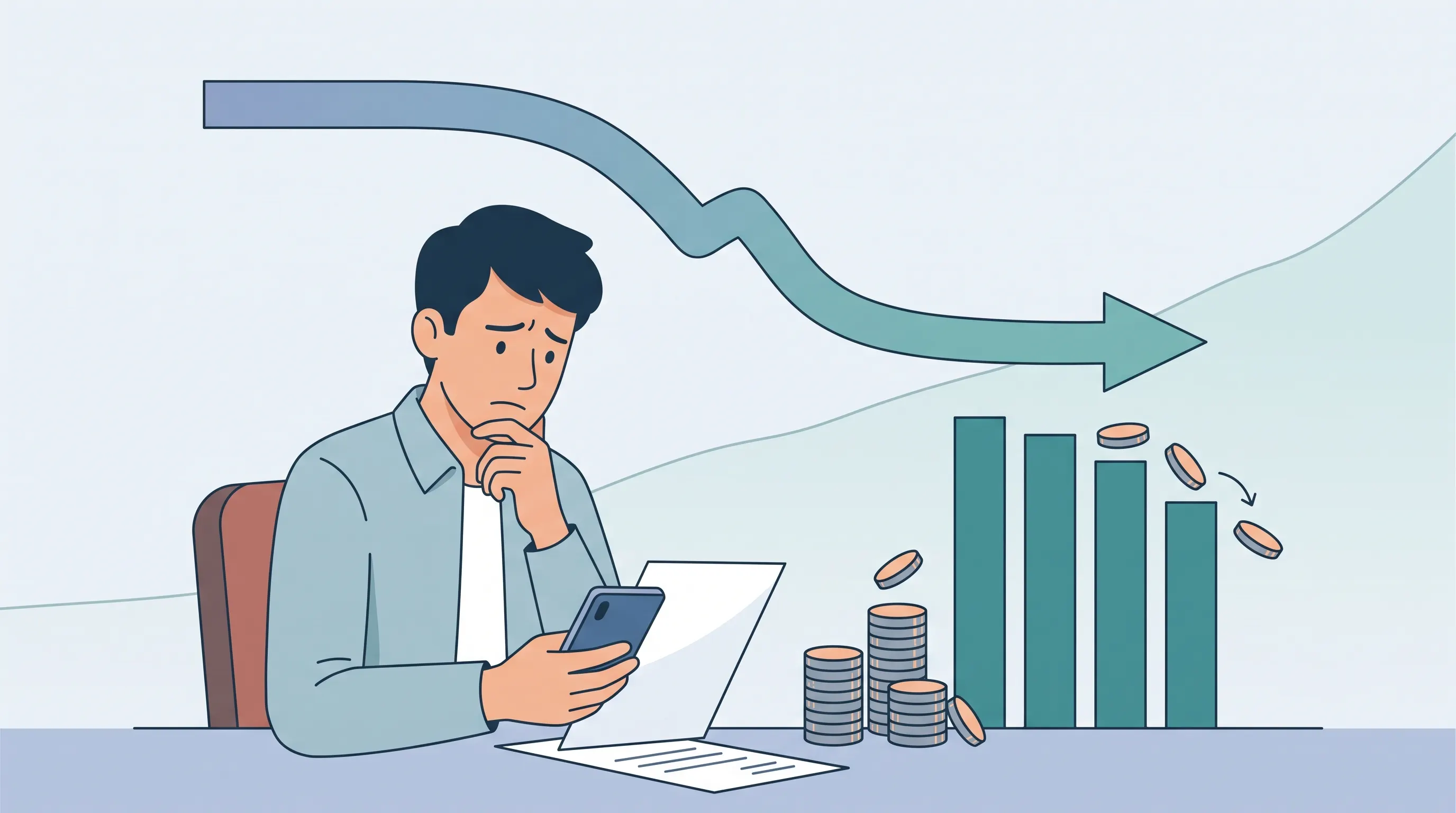
You've been making your loan payments every month, but your statement balance barely moves. It even looks bigger in some months than it did before. It's a frustrating place to be. There are plenty of people who end up there and don't know why.
Most of the time this is due to the mechanics of how loans are built, not a mistake on your part. This guide explains what increases your total loan balance, where your money actually goes each month and what changes will finally get that number to go down.
- Interest is front-loaded: Early loan payments go predominantly to interest charges rather than your principal balance.
- Capitalisation: Unpaid accrued interest rolled back into your loan principal causes you to pay interest on interest.
- Minimum payments: Paying only the minimum requirement stretches repayment over decades and dramatically inflates lifetime costs.
- Negative amortisation: When monthly payments fail to cover accruing monthly interest, your total loan balance will actually increase.
- Opportunity cost: Money spent on loan interest represents lost investment compounding potential that far exceeds the interest dollar figure alone.
The Short Answer to Why Your Loan Balance Isn't Decreasing
During the early part of a loan, a large share of each payment is interest, so only a tiny bit of it goes toward the amount you borrowed. And if you throw in an occasional late fee, or a period where unpaid interest is rolled back into the loan, the balance can remain almost stationary while payments keep leaving your account.
What Increases Your Total Loan Balance? Eight Common Reasons
1. Interest is paid before your principal
When you make a payment, the lender applies it to interest first. Whatever is left over goes to paying down the principal, the amount you actually borrowed.
That means a first-month payment includes about $150 of interest on a $10,000 balance at 18 percent. If you are paying $250, only about $100 goes toward what you owe. This also answers a question many borrowers have: how much of my payment goes to interest? Most of it at the beginning. As the balance shrinks, that ratio slowly flips.
2. Just making minimum payments
The minimum payment remains low, just enough to cover the interest and a little bit of the principal. That payment keeps your account current, but it extends the repayment period over years and allows interest to accrue in the meantime. The obvious example is credit cards. A minimum only habit can turn a modest balance into a decade of payments.
3. Payment late or missed
When you skip a due date, two things usually happen. Interest keeps racking up on the full balance. Plus, the lender usually charges a late fee. In the US that fee is often around $40 on credit cards but it varies from card to card and where you live. Some lenders can increase your rate if you fall behind over and over again. It all goes toward what you owe.
4. Capitalisation of interest
Capitalisation is when unpaid interest is added to your principal, so you end up paying interest on interest. Federal student loans used to capitalise interest at several trigger points and private loans still do so after grace periods, deferments and forbearances.
5. Deferment and forbearance
Sometimes pausing payments is the right thing to do when you're having a rough patch, and can be a lifeline. The problem is, most loans will continue to accrue interest while payments are on hold. Once the pause is over, that accrued interest is often capitalised, so you return to a balance higher than the one you left.
6. Rising rate
Fixed-rate loans carry the same interest rate for the life of the loan. Variable rate loans are tied to the market. If you have a variable rate and rates rise, more of each payment goes to interest, meaning less is left over to reduce the principal, even if the payment amount doesn't change.
7. Longer loan term
Long terms are alluring because they lower the monthly payment by stretching the loan over more years. You pay for that lower payment with more years of interest payments. While a 72-month car loan may feel painless from month to month, you're paying the lender interest for two additional years compared to a 48-month term, and the total you pay back balloons far beyond what the shorter loan would have cost.
8. Negative amortisation
This is where a balance actually grows as you pay it off. It happens when the monthly payment doesn't quite cover the interest that's being charged, and the difference gets added to the principal. It can be caused by some types of mortgages, and some income-driven student loan plans. If you're making regular payments but your balance is going up, negative amortisation is probably the problem.
How Interest Works on Your Loan (Amortisation)
Take a $5,000 loan at 12 percent and pay $250 a month. Here's what the first three months look like:
| Month | Starting Balance | Interest Charge | Goes to Principal | Ending Balance |
|---|---|---|---|---|
| 1 | $5,000 | $50 | $200 | $4,800 |
| 2 | $4,800 | $48 | $202 | $4,598 |
| 3 | $4,598 | $46 | $204 | $4,394 |
Month one's payment includes $50 in interest. As the balance falls, the interest charge shrinks a little each month, so a bit more of your fixed payment starts to hit the principal. It's called amortisation, and it's why it feels like you're making slow progress at first and faster progress later.
Use our Debt Payoff Calculator to simulate extra monthly payments and compare Snowball vs. Avalanche strategies live.
How Much Interest Will I Pay Over the Term of the Loan?
If you want a quick estimate rather than a full amortisation schedule, there is a simple calculation:
If you borrow $20,000 for a car at 10 percent interest for five years, your monthly payment will be about $425. Over 60 months you'd pay about $25,500, of which about $5,500 is interest.
The numbers are much bigger on long loans. Keep that in mind the next time a low monthly payment makes a big loan seem harmless: on a 30-year mortgage, total interest can approach the price of the home itself.
Debt as a Metric for Work-Hours
Dollar amounts can feel far away, so try to translate interest into time. Divide the total interest of the loan by your hourly wage. At $20 an hour, that $5,500 in interest from the car loan example above is 275 hours, or nearly seven weeks of work that go toward interest alone.
It's a rough exercise, but running your own debt through it tends to make the cost land in a way a statement never does.
The Cost of Debt in Opportunity Cost
There is one cost that never appears on any statement: what your payments could have done elsewhere. Economists call this the opportunity cost.
For example, consider a $50,000 student loan at 6 percent repaid over ten years. The monthly payment comes out to around $555, and over the entire term the borrower pays back almost $66,600. Now imagine that same $555 put into investments instead. Assuming a long-term average annual return of 7 percent (which is a projection, not a promise), that money could grow to about $96,000 over the ten years. The real heft of the loan is the difference between what you paid back and what you could have built. That is way upstream of the interest figure alone.
Do You Pay Off Debt Or Invest?
When you begin to think about opportunity cost, a natural question is: should you pay off debt or invest any spare cash?
Compare the interest rate to what you could reasonably expect to earn if you invested. Debt with a high interest rate, particularly credit cards, generally costs more than the likely return of a diversified portfolio, so paying that off first tends to win. It's a closer call with lower-rate debt, like some student loans or older mortgages in the 4 to 5 percent range, and there's an argument for investing while making steady payments if your expected return is higher.
How to Stop Your Balance Growing
The habits that undo a stubborn balance are not complex:
- Pay more than the minimum: Any extra payment goes straight toward principal and cuts down future interest charges.
- Use windfalls: Put bonuses, cash gifts, or tax refunds toward lump-sum principal reductions.
- Avoid late fees: Set up automated payments to ensure late penalties and penalty APRs never trigger.
- Pay interest during forbearance: If pausing payments is necessary, pay at least the accruing monthly interest to prevent capitalisation.
- Refinance high-rate debt: If your credit score has improved, refinancing at a lower interest rate directs more of each monthly check toward principal.
Watch Your Own Numbers
It helps to read about amortisation, but what tends to change behaviour is seeing your particular loan. Enter your balance, rate and payment in our Debt Payoff Calculator and see how a modest extra payment changes the timeline. A small monthly increase can cut years off a loan and save thousands of dollars in interest.
Frequently Asked Questions
What increases your total loan balance the most?
The biggest driver is typically capitalised interest. If you don't pay the interest, it gets tacked onto the principal and all future interest is calculated on the larger amount. Long terms, late fees and penalty rates add to it too.
Why is the balance on my loan not decreasing?
A rising balance means your payment is not covering all the interest that is accruing, a situation called negative amortisation. Common causes are a variable rate that has increased, minimum-only payments, or paused payments.
How much of my payment goes to interest?
It depends where you are in the loan. A large part of the payment in the early months is interest, and as the balance declines, a larger part of the payment is applied to the principal.
How do I pay down my loans faster?
Mostly by paying more than the minimum and applying extra money to principal. Refinancing to a lower rate, plus avoiding late payments, also helps.
Should I pay off debt or invest?
When tackling high-interest debt, it's usually worth paying it down because the savings are guaranteed. If you have a debt with a low interest rate, you can invest and pay only the minimum on the debt, as long as you are likely to get a higher return on your investment than the interest rate on the debt.
The Bottom Line
If your balance isn't moving it's seldom a sign you're failing with money. It's largely the loan's design coming through, with interest front-loaded and small charges pushing the total up. You can push back once you know what increases your total loan balance. Pay a little extra. Keep your payments on time. Sidestep the pauses that capitalise interest. Work from a plan. Keep doing that and the number that felt frozen starts to go down.