Debt-to-Income (DTI) Calculator
Calculate Your Front-End and Back-End DTI Ratios
Last updated: August 2026
Debt-to-Income (DTI) Ratio Calculator: What Lenders See That You Don't

There's a specific kind of dread that shows up when you're applying for a loan. Your credit score checks out, your paperwork is in order, and then somewhere in the process a lender casually mentions your DTI ratio and asks if it's under 36%. If your honest reaction is "my what?" — you're in good company. Most people never sit down and calculate this number until the moment it actually matters.
A debt to income ratio calculator fixes that particular blind spot. Feed it your income and your monthly debts, and it tells you, in plain terms, exactly where you stand — before anyone else gets to tell you first.
What Is DTI Ratio?
Your debt-to-income ratio, or DTI, is really just a comparison: how much you owe every month against how much you bring in. Lenders care about it for a simple reason — your credit score shows how you've handled debt in the past, but DTI shows whether you can actually handle a new payment right now, today, with your current income.
There are two versions of this number, and most lenders check both:
- Front-End DTI (Housing Ratio): Just your housing costs — rent or mortgage, property tax, and insurance — divided by your income.
- Back-End DTI (Total Debt Ratio): Housing costs, plus every other debt payment you're making each month — credit cards, auto loans, student loans, whatever else — divided by your income.
Why does this split matter? Because it's entirely possible to look fine on one and get declined on the other. Understanding front end vs back end DTI helps you see where a loan application might actually run into trouble. Back-end DTI tends to be the number that makes or breaks things, since it's the full picture rather than just the housing slice of it.
How to Use This DTI Calculator
Our free debt to income ratio calculator asks for seven simple inputs. It also keeps a dedicated field for property tax, which a lot of the basic tools online skip over. And like everything else on this site, it runs entirely in your browser — no sign-up, no login, no credit check, nothing.
- Gross Income ($) — This DTI calculator will convert yearly income to monthly automatically, so just enter whichever figure is easiest for you to pull up. (If you only know your hourly wage, you can convert it using our hourly to salary calculator).
- Monthly Rent / Mortgage ($) — If you already own, use your current payment. House-hunting instead? Enter the target mortgage payment you're actually considering — that way you can see how a new purchase would move your DTI before you ever make an offer.
- Monthly Property Tax & Insurance ($) — Kept separate from the mortgage line so the math stays accurate.
- Monthly Credit Card Minimums ($) — Not your balance, just what's due.
- Monthly Auto Loans ($) — Any car payments you're on the hook for.
- Monthly Student Loans ($) — Whatever your monthly obligation happens to be.
- Monthly Other Recurring Debts ($) — Personal loans, alimony, child support, anything else that shows up every month.
Hit Calculate, and three results come back: your Front-End DTI, your Back-End DTI, and a plain-language Qualifying Status — Safe, Moderate, or High. Print it, copy it, download it, whatever's useful for you.
That Qualifying Status label is really the whole point. A number on its own, like "38%," doesn't mean much unless you already know the thresholds by heart. The status just tells you, immediately, where that number actually puts you.
How to Calculate Debt to Income Ratio: The Formula, Explained Simply
Both versions of DTI boil down to the same idea — debt divided by income, then turned into a percentage.
Front-End DTI = (Rent/Mortgage + Property Tax + Insurance) ÷ Gross Monthly Income × 100
Back-End DTI = (All Monthly Debt Payments) ÷ Gross Monthly Income × 100
A Worked Example
Let's say you're bringing in $6,000 a month before taxes, and your monthly obligations look something like this:
- Rent/Mortgage: $1,500
- Property Tax & Insurance: $200
- Credit Card Minimums: $150
- Auto Loan: $300
- Student Loan: $200
Front-End DTI: ($1,500 + $200) ÷ $6,000 = 28.3%
Back-End DTI: ($1,500 + $200 + $150 + $300 + $200) ÷ $6,000 = $2,350 ÷ $6,000 = 39.2%
Here, the front-end number looks perfectly fine, but the back-end ratio slides into the 36-43% range. That still likely gets you approved for a mortgage — just expect a bit more paperwork, or maybe a slightly higher rate than someone whose back-end number sits lower.
What Counts as Debt (and What Doesn't)
When you're filling in those debt fields, the rule of thumb is simple: only count payments that actually show up on your credit report. Not general living costs.
- Counts: credit card minimum payments, car loans, student loans, any other mortgage you're still paying down, personal loans, alimony, child support.
- Doesn't count: your current rent (once you're modeling a new mortgage scenario), utilities, your phone bill, groceries, car insurance, life insurance, or general day-to-day spending.
One thing worth flagging if you've got student loans: if they're sitting in deferment or forbearance, your credit report might show a $0 payment. Lenders generally won't accept that at face value — instead, they'll typically use 1% of your outstanding balance as your monthly payment for DTI purposes. So a $40,000 balance in deferment could still add roughly $400 a month to a lender's math, even though you're not actually paying anything right now.
What Is a Good Debt to Income Ratio?
Lenders tend to sort DTI into three rough tiers, which is basically what our calculator's DTI Qualifying Status is built around:
| DTI Range | Status | What It Means |
|---|---|---|
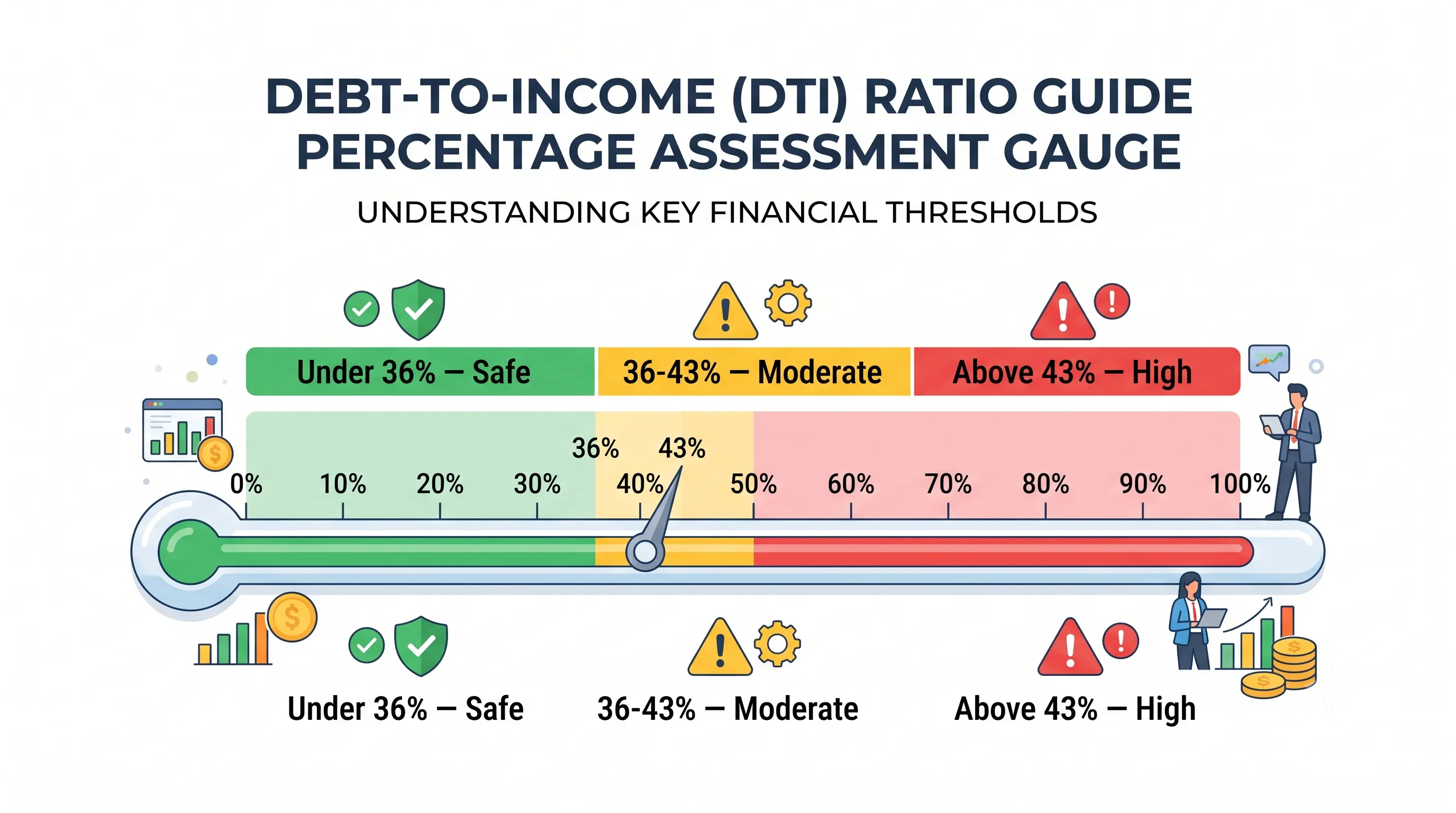
| Under 36% | Safe | Considered ideal. Low-risk borrower territory, and usually the best rates available. |
| 36% – 43% | Moderate | Still workable for most lenders, though expect more paperwork or a slightly higher rate. |
| Above 43% | High | Getting risky. Most traditional mortgage underwriters want a back-end DTI at or below 43% for a Qualified Mortgage. |
Lenders categorize DTI ratios into safe, moderate, and high-risk tiers to assess your borrowing capacity.
This is what people usually mean when they talk about the 36% DTI rule — it's the benchmark most articles and advisors point to as a healthy target. And it's not a bad number to aim for. But it's worth knowing that it isn't really a hard approval cutoff, either.
The Truth About the 36% "Rule"
A lot of what's floating around online treats 36% like a strict line you can't cross. In reality, individual lenders don't set that number — mortgage agencies do. Fannie Mae, Freddie Mac, FHA, VA, USDA — they build the automated underwriting systems that actually evaluate your whole loan file, not just one isolated ratio. And once you look at real approval data, the numbers tend to run noticeably higher than 36%:
- Conventional loans: Things start getting tricky around 45%, though approvals up to 50% do happen with a strong file overall.
- FHA loans: Routinely approved up to 50%, sometimes as high as 57%.
- VA loans: A pretty wide range — roughly 41% to 60%.
- USDA loans: Usually somewhere between 41% and 46%.
- Jumbo loans: More conservative, typically capped around 41-43%.
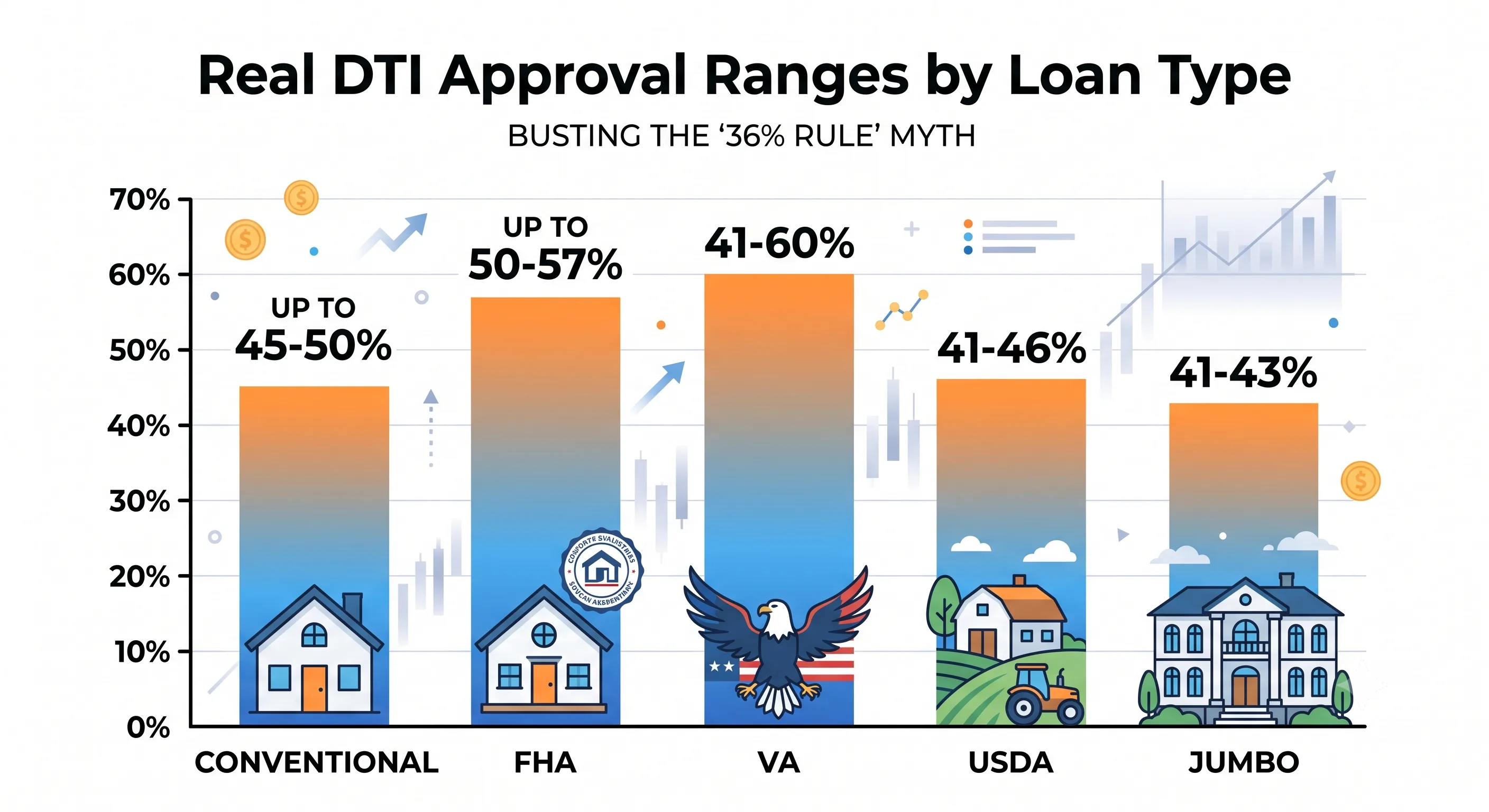
Actual approval thresholds for different mortgage programs often run significantly higher than the standard 36% guideline.
None of that means you should chase the highest number a lender might technically let you have. Just because you can qualify at 45% or 50% doesn't mean you should — your lender doesn't know your budget the way you do, and neither does your real estate agent. Treating 36% as your own personal ceiling, even when a lender would let you go higher, is usually the safer move if you want your mortgage payment to leave room for the rest of your life.
DTI for Mortgage vs. Personal Loan vs. Auto Loan
Not every lender is working from the same rulebook. Mortgage lenders tend to be the strictest of the bunch, generally keeping back-end DTI around 43% for a Qualified Mortgage, though some programs will flex a bit higher if you bring compensating factors like a big down payment or excellent credit.
Most people reach for a DTI calculator for mortgage purposes specifically, but the same math holds up everywhere else too. If you're eyeing a debt to income ratio for personal loan approval, lenders there tend to have a bit more give — some will go up to 45-50%, especially with steady income and a solid credit history behind you. So if you're wondering whether 45% DTI too high for a personal loan, the honest answer is: it depends who you ask, but it's on the higher side and will probably narrow your options or nudge your rate up.
Auto lenders land somewhere in the middle, often comfortable up around 45-50% back-end DTI for borrowers who otherwise look strong. If you are shopping for a car, running the numbers through a reverse auto loan calculator helps you find the max vehicle price you can afford based on your target payment.
What DTI Ratio Disqualifies You?
This is usually the question people actually want answered, so here it is plainly: for a standard Qualified Mortgage, a back-end DTI above 43% typically knocks you out of conventional loan programs. Some government-backed options — certain FHA programs, for instance — allow flexibility past that number if the rest of your file is strong, but 43% remains the widely used ceiling in conventional underwriting.
For personal loans and auto loans, there's no single agreed-upon cutoff — it really does vary lender to lender — but once you cross 50%, approval gets meaningfully harder no matter the loan type, since lenders start questioning whether you can realistically absorb another payment.
Working Backward: How Much Mortgage Payment Can You Afford?
Sometimes the more useful question isn't "what's my DTI right now" — it's "how big a mortgage payment can I add without pushing that number too far?"
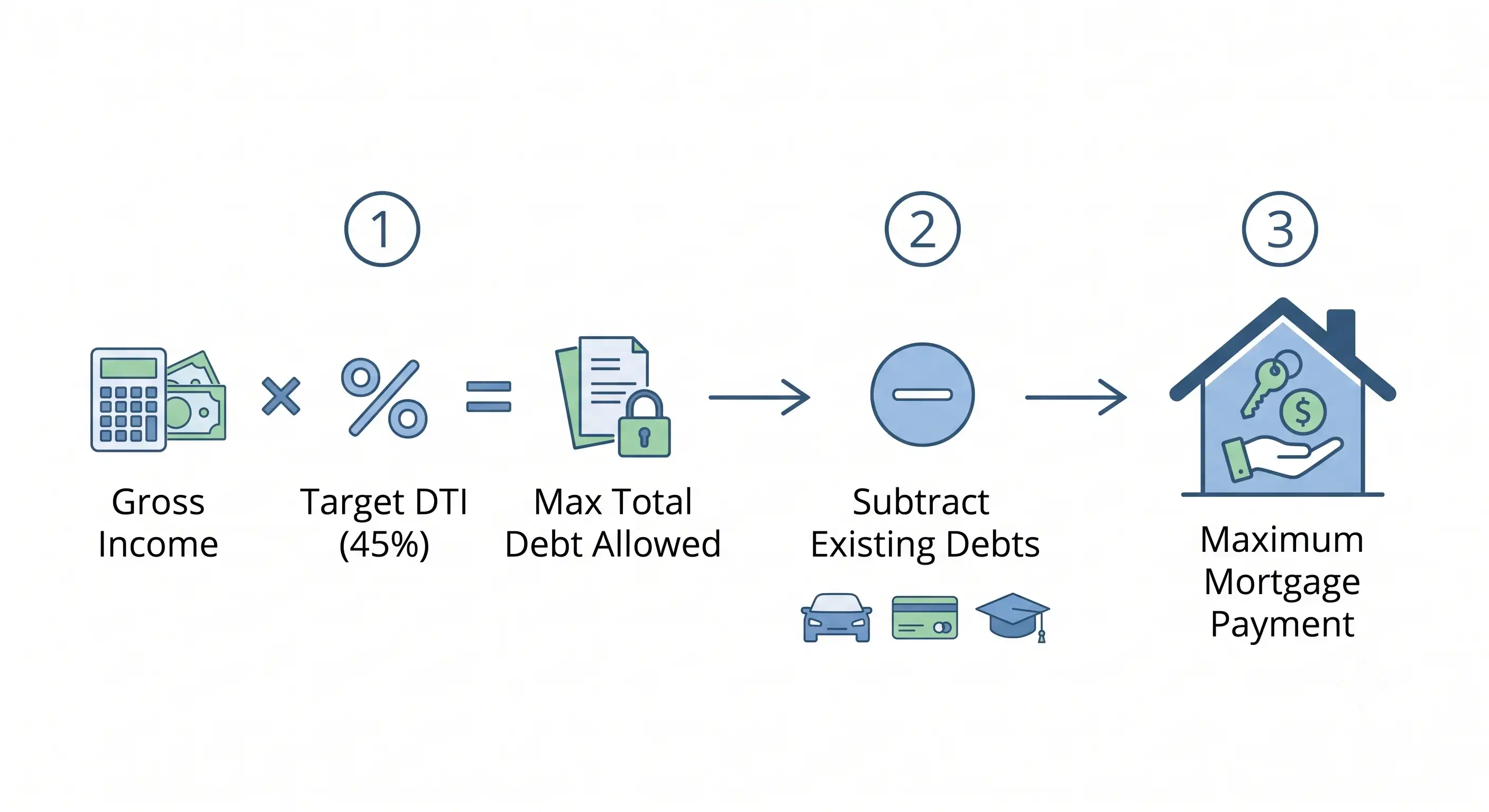
Here's the approach: pick a target DTI (45% is a reasonable ceiling that lines up with most lenders and loan types), multiply it by your gross monthly income to get your maximum allowed total debt, then subtract whatever you're already paying each month. What's left over is roughly the biggest mortgage payment you could realistically take on.
Example: Say you're earning $5,000 a month, and your existing debts — credit card minimum, car loan, student loan — add up to $1,000.
- Maximum total debt at 45% DTI: $5,000 × 0.45 = $2,250
- Maximum mortgage payment: $2,250 − $1,000 = $1,250
Working backward from a target DTI is the safest way to find your true monthly housing budget.
That $1,250 is roughly where most lenders would draw the line for you. It doesn't mean you should aim right at it — plenty of buyers who technically qualify at that level choose something smaller, just for breathing room. But it gives you an actual number to plan around instead of guessing your way through open houses.
If Your DTI Is Too High
If a lender tells you your DTI is what's holding up approval, you've got more room to maneuver than it might feel like in that moment:
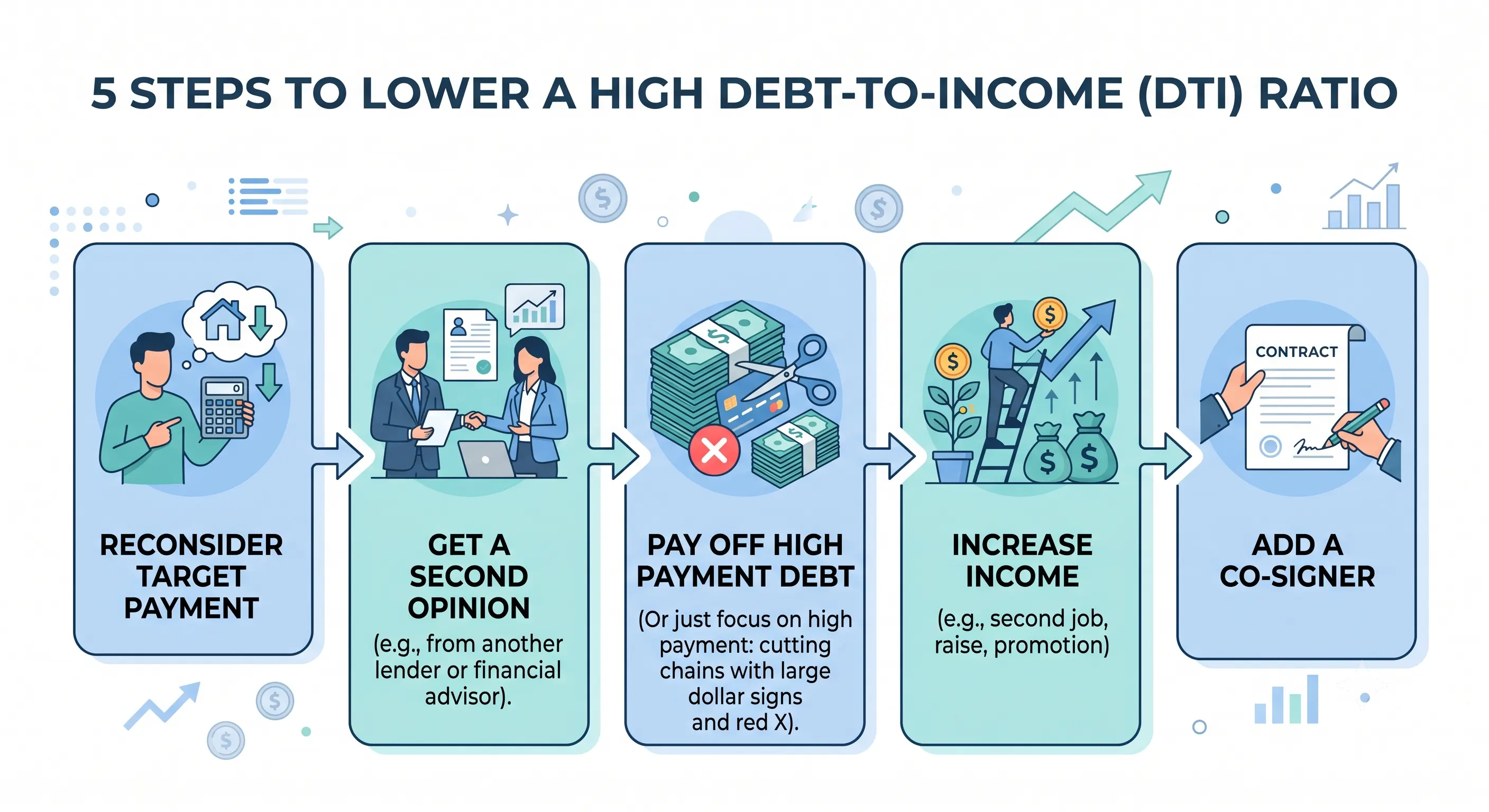
- Reconsider your target payment. If $1,500 pushes you over the line but $1,250 doesn't, that's worth listening to — not just a wall to bang your head against.
- Get a second opinion. DTI limits come out of automated underwriting systems, not individual loan officers having a bad day. One lender saying no near the edge doesn't mean everyone will.
- Pay down whichever debt has a payment out of proportion to its balance. Clear it, and that payment disappears from your DTI entirely — often the fastest way to move the needle.
- Ask about a raise, or document income you haven't been counting. Growing the income side works just as well as shrinking the debt side.
- Bring in a co-signer, as a last resort. Their income joins the calculation, but so does their debt — so this only helps if their overall profile is genuinely stronger than the gap you're trying to close.
Your Privacy, Protected
If part of what's kept you from running these numbers is not wanting to hand your financial details to some random site, or trigger an actual credit check — a debt to income ratio calculator no credit check option is exactly what this is. No login, no email, no credit pull. You're just doing arithmetic with numbers you already have sitting in front of you. Everything happens locally in your browser, and none of it gets stored or sent anywhere.
How to Lower My Debt to Income Ratio
If your number came back higher than you were hoping, you've really only got two levers to pull: cut debt, or grow income. A few ways to actually move that needle:
- Pay off high-interest debt first. Credit cards usually carry the worst minimum-payment-to-balance ratio of anything you're likely holding, so clearing them tends to improve your DTI faster than tackling other debts first. A debt payoff calculator can help you weigh snowball against avalanche and figure out the quickest route.
- Don't take on new debt right before applying for a loan. A new car payment or credit card right before a mortgage application can push a previously fine DTI over the edge.
- Grow your income wherever you can. A raise, side income, documented freelance work — all of it lowers your ratio by growing the denominator.
- Refinance something for a lower monthly payment. Stretching the term or landing a better rate can shrink your monthly obligation even if the balance itself doesn't change.
- Chip away at revolving balances, not just the minimums. It won't move your minimum payment overnight, but some lenders reassess based on updated balances closer to underwriting time.
Fitting DTI Into Your Bigger Financial Picture
Your DTI is a snapshot, not the whole story. It's worth running your everyday spending through a 50/30/20 budget calculator too, just to see whether your current debt load actually fits inside a sustainable budget — or whether it's already stretching things thin before you've even added a new payment. Get both numbers into a healthy range, and you're in a genuinely stronger position whenever you do apply for financing.
Frequently Asked Questions
What is a good debt-to-income ratio?
Generally, a back-end DTI under 36% is considered ideal, and most lenders will still work with you up to 43% for a standard mortgage. Past 43%, qualifying for a conventional loan gets noticeably harder.
What DTI ratio disqualifies you for a mortgage?
For most conventional Qualified Mortgages, a back-end DTI above 43% typically disqualifies you — though some government-backed programs make exceptions when the rest of your file is strong.
How is front-end DTI different from back-end DTI?
Front-end DTI only counts housing costs — rent or mortgage, property tax, insurance. Back-end DTI adds in everything else too, like credit cards, auto loans, and student loans.
Is 45% DTI too high for a personal loan?
It's on the higher end, honestly. Some personal loan lenders will still approve borrowers up around 45-50%, particularly with strong credit and steady income, but it tends to narrow your options or push your rate up.
Does this calculator check my credit or require sign-up?
No, on both counts. It runs entirely in your browser — no login, no credit check, nothing stored or sent anywhere. You're just plugging in numbers you already know.
Is 36% a hard rule, or can I qualify with a higher DTI?
It's a conservative, commonly cited target rather than a strict cutoff. Real approval limits come from mortgage agencies through automated underwriting, and they often run higher — up to 45-50% for conventional loans, and even further for some FHA and VA programs, depending on the rest of your financial picture.
What DTI do lenders want for mortgage pre-approval?
Most conventional lenders prefer a back-end DTI of 36% or lower and will often approve up to 43% to 45% with good credit and savings. FHA loans can go higher, sometimes close to 50%, with strong compensating factors. Check both your front-end and back-end ratios here before you apply so there are no surprises.
How can I lower my DTI ratio fast?
The quickest ways are to pay off a small loan or credit card completely (which removes its monthly payment), pay down card balances so the minimum payment drops, or add documented income such as a co-borrower. Avoid opening new credit while you are trying to qualify. The Debt Payoff Calculator can show you which debt to clear first.
How is DTI calculated if I am self-employed?
Lenders use your net self-employment income, usually averaged over your last two years of tax returns, not your gross sales. That means business write-offs lower the income used for DTI. Enter that averaged monthly net income in this calculator to see what a lender will see.
Final Thoughts
Your DTI ratio shouldn't be something a lender reveals to you halfway through an application. Run the numbers yourself first, and you walk into any loan conversation already knowing exactly where you stand — whether that's comfortably in "Safe" territory, or with a clear number to work toward if you're not quite there. Calculate it, check it against whatever loan type you're actually pursuing, and if it's higher than you'd like, you now have an actual plan for bringing it down instead of just hoping for the best.