Rule of 72 Calculator
Estimate Doubling Time and Compare Against Exact Math
Last updated: August 2026
The Rule of 72 calculator provides a quick way to determine how long it will take an investment to double. Type in your annual interest rate and it divides 72 by that rate, showing the number of years. Instead, you can enter a target number of years and it works backward to tell you what return you'd need.
It's that one shortcut that's kept the rule alive for over 500 years. You don't need a spreadsheet or a degree in finance to use it, just simple division you can do in your head.
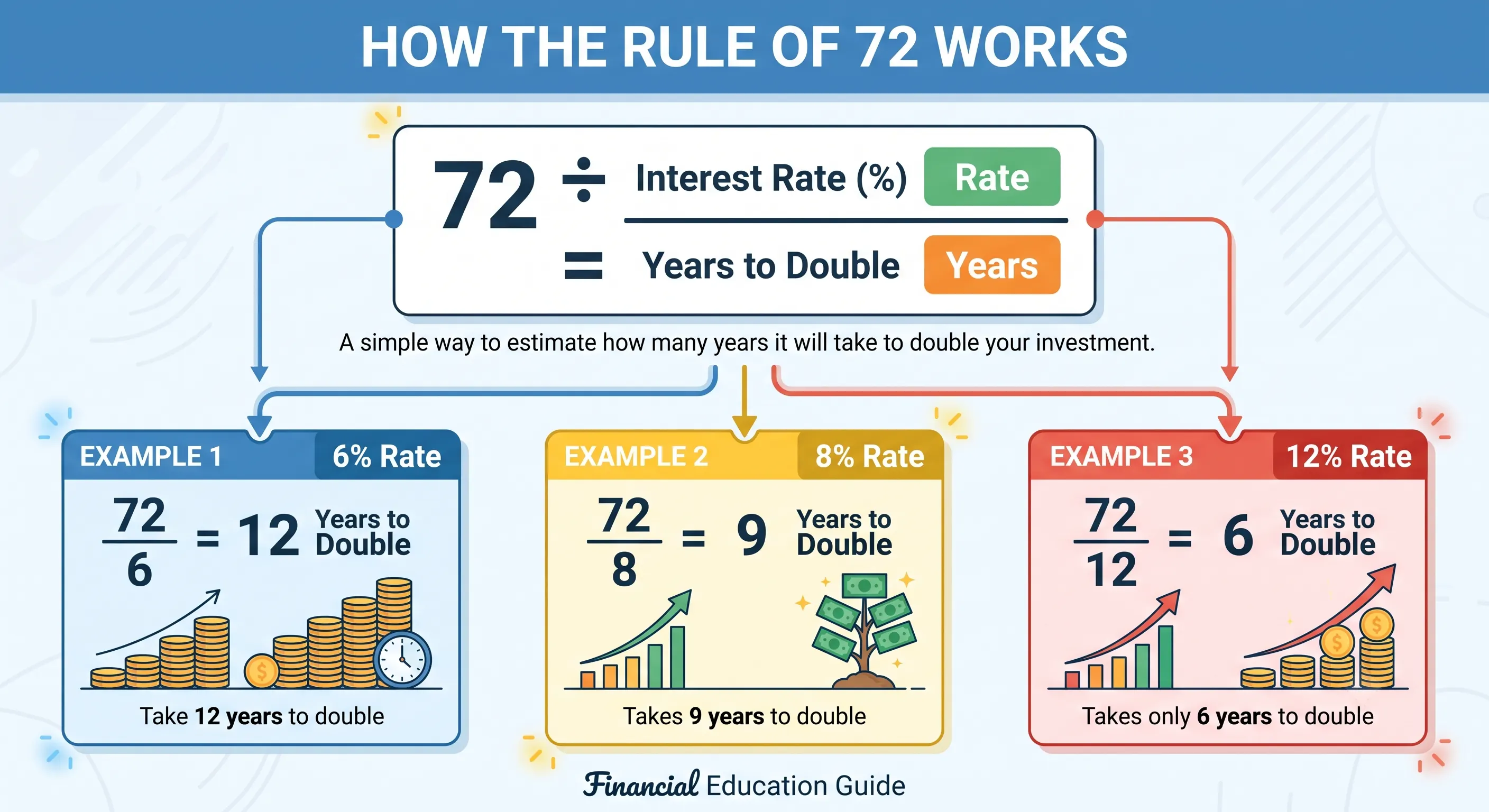
What Is the Rule of 72?
The Rule of 72 is a quick mental shortcut to determine how many years it takes for money to double at a fixed annual rate of return. Take 72 divided by the interest rate, and the answer is the approximate time to double.
Money doubles in about 9 years at 8 percent, because 72 divided by 8 is 9. It is about 12 years at 6 percent. Only about 6 years at 12 percent. The greater the return, the less time it takes, and the rule lets you see that right away.
It works on the principle of compound interest. Growth builds on previous growth, so the doubling time is fairly predictable and 72 happens to track it well. This is a rule of compounding, so it does not apply to simple interest.
The Rule of 72 Formula
The formula for the rule of 72 is simple:
Or you can reverse it if you know your time frame and want the rate needed:
So if you want to double your money in 8 years, you need about 9 percent a year, since 72 divided by 8 is 9.
The shortcut is based on exact math. The actual doubling time is given by logarithms: t = ln(2) / ln(1 + r), where ln(2) is approximately 0.693. Instead of the messier 69.3 we use the number 72 because it divides cleanly by 1, 2, 3, 4, 6, 8, 9 and 12, making the mental arithmetic painless. That's the whole point of the trade-off, a little accuracy for a lot of convenience.
Rule of 72 Example
Suppose you invest $10,000 and it generates an average of 9 percent a year. Divide 72 by 9 and you get 8. So your money should grow to about $20,000 in 8 years. Wait another 8 years at the same rate and it will double again to about $40,000.
Here's how a few common rates translate on that same $10,000:
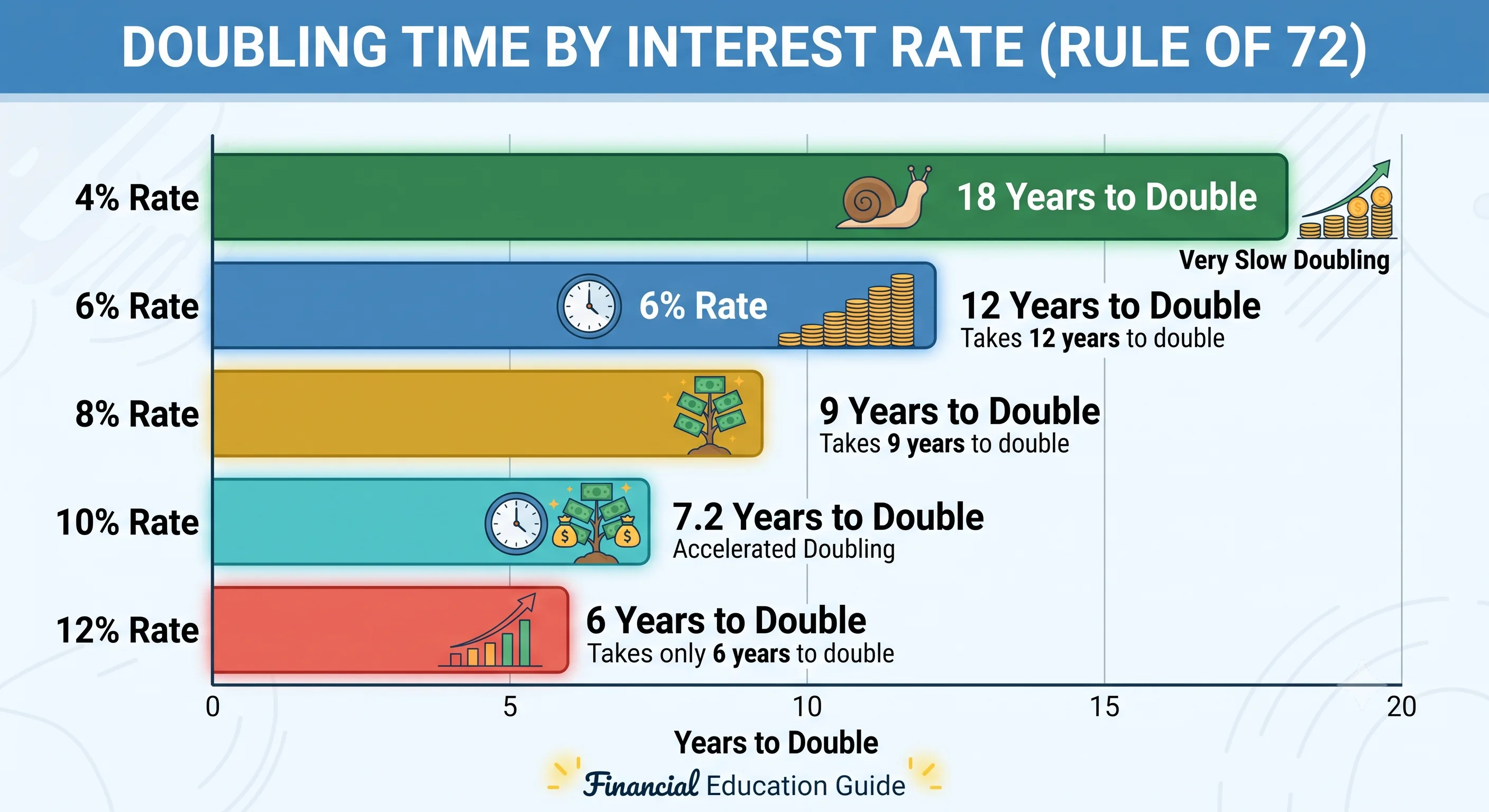
| Annual Rate | Years to Double | Value After 1st Doubling | Value After 2nd Doubling |
|---|---|---|---|
| 4% | 18 years | $20,000 (yr 18) | $40,000 (yr 36) |
| 6% | 12 years | $20,000 (yr 12) | $40,000 (yr 24) |
| 8% | 9 years | $20,000 (yr 9) | $40,000 (yr 18) |
| 9% | 8 years | $20,000 (yr 8) | $40,000 (yr 16) |
| 12% | 6 years | $20,000 (yr 6) | $40,000 (yr 12) |
A few percentage points make a tremendous difference over decades. At 6 percent your money doubles twice in 24 years, reaching $40,000. At 12 percent it doubles four times in that same window, landing at $160,000. That is four times as much money from double the rate, thanks to compound growth.
How Accurate Is the Rule of 72?
The rule is accurate across standard investment returns, usually falling within a fraction of a year from the actual figure between 6 and 10 percent.
Accuracy begins to taper at very low or very high rates. At 2 percent, the exact doubling time is 35.0 years while 72 / 2 gives 36. At 20 percent, the exact time is 3.8 years while 72 / 20 gives 3.6.
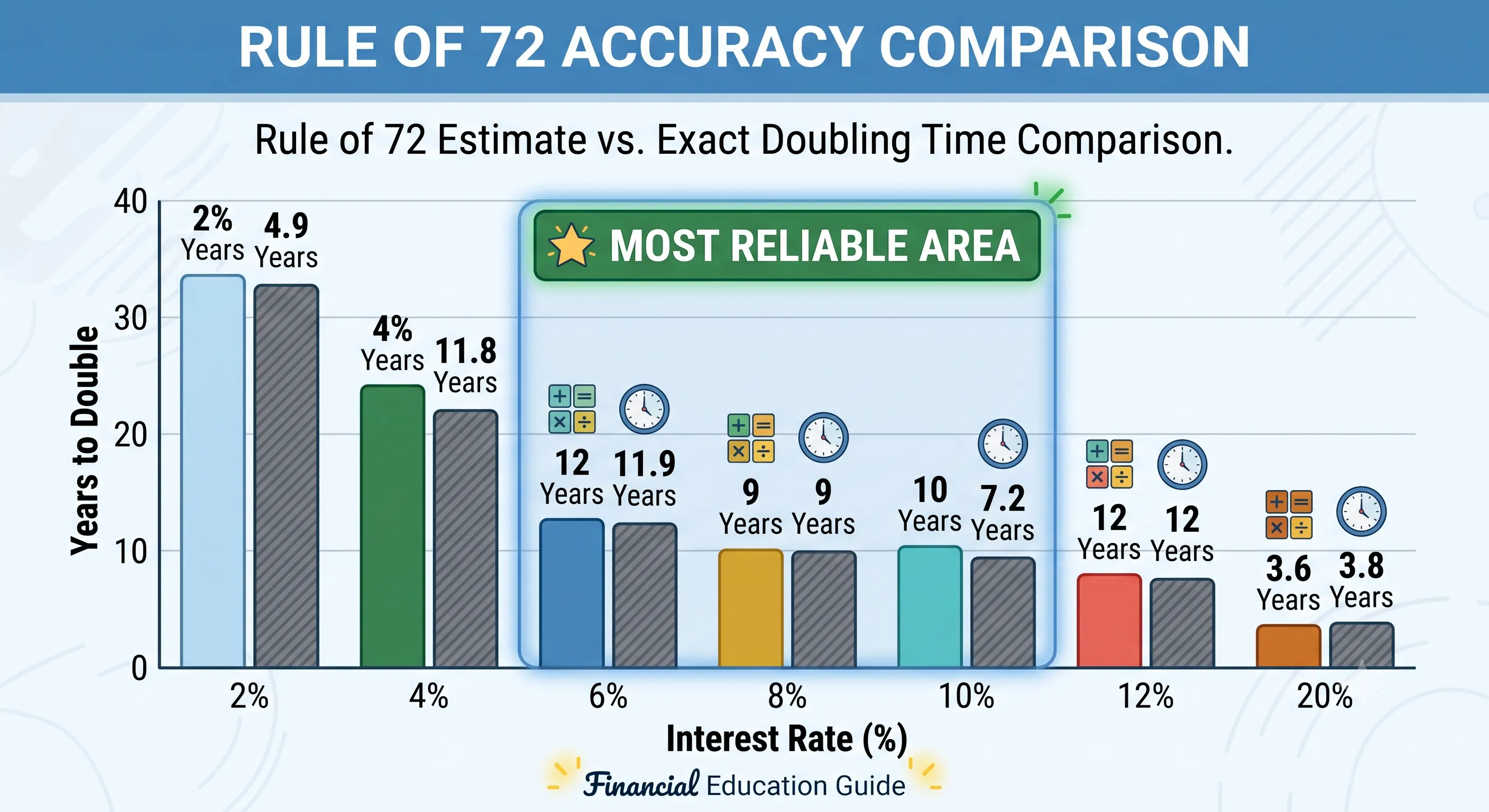
| Rate | Rule of 72 Estimate | Exact Doubling Time | Difference |
|---|---|---|---|
| 2% | 36.00 years | 35.00 years | +1.00 yr |
| 5% | 14.40 years | 14.21 years | +0.19 yr |
| 8% | 9.00 years | 9.01 years | -0.01 yr |
| 10% | 7.20 years | 7.27 years | -0.07 yr |
| 15% | 4.80 years | 4.96 years | -0.16 yr |
| 20% | 3.60 years | 3.80 years | -0.20 yr |
For daily continuous compounding, 69.3 is mathematically ideal. For daily or monthly compounding, 70 is often closer. But for annual compounding in standard ranges, 72 is the gold standard for speed and simplicity.
Using the Rule of 72 for Debt and Inflation
The rule isn't just for growing wealth — compounding works in reverse against you on debt and inflation.
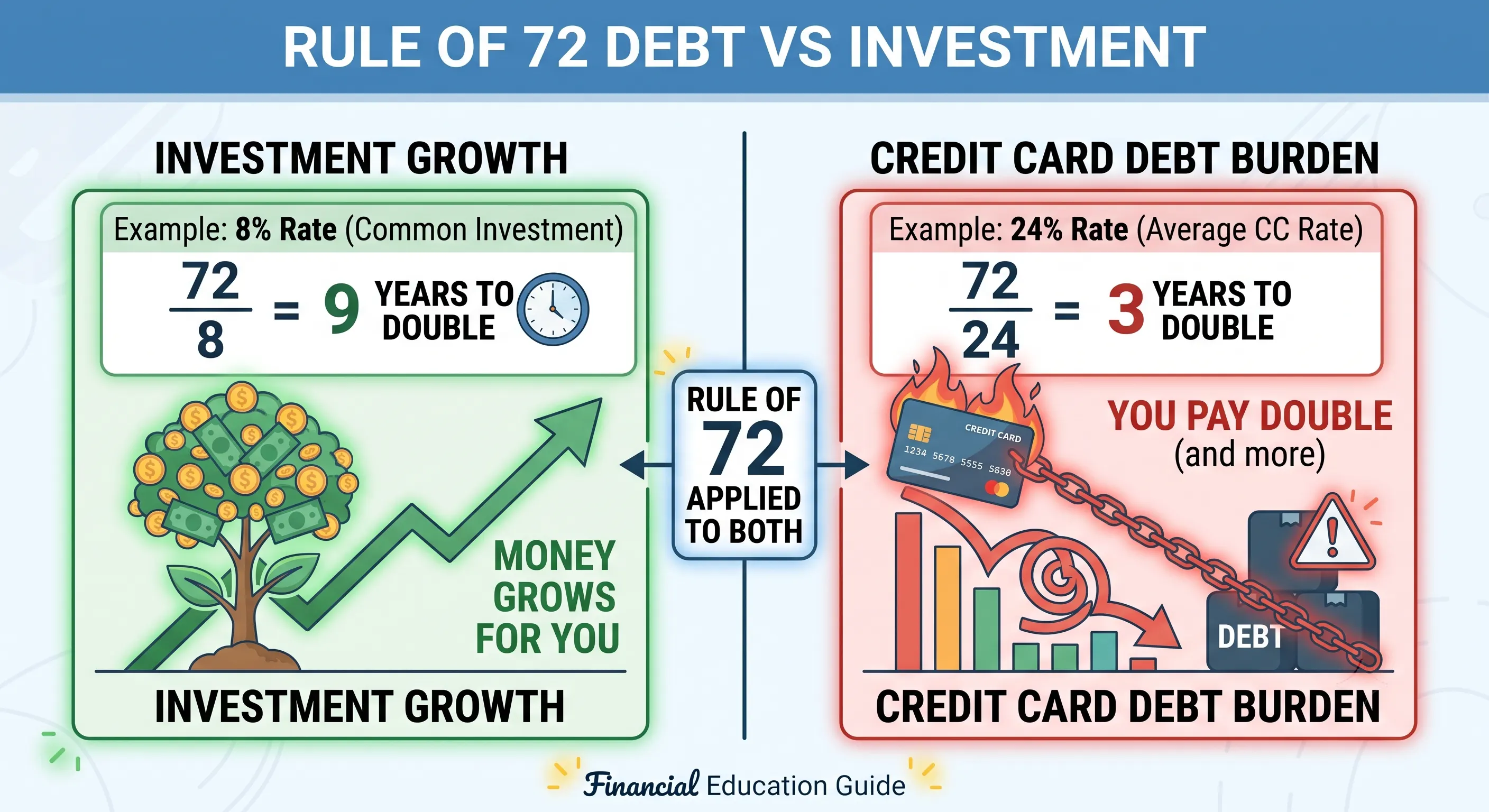
If you carry a credit card balance at a 22 percent APR without paying it down, 72 / 22 gives roughly 3.3 years. That means your debt balance doubles in just over three years on interest alone.
For inflation, if annual inflation averages 3.5%, then 72 / 3.5 = ~20.5 years. In approximately 20 years, the purchasing power of your cash is cut in half.
Frequently Asked Questions
What is the Rule of 72?
The Rule of 72 is a quick, shortcut formula to estimate how many years it will take for an investment to double in value given a fixed annual rate of return.
Why is 72 used instead of 69 or 70?
While 69.3 is exact for continuous compounding, 72 is chosen because it has many small integer divisors: 1, 2, 3, 4, 6, 8, 9, and 12. This makes mental math effortless for everyday interest rates.
Does the Rule of 72 work for simple interest?
No. The Rule of 72 specifically models exponential compound growth where interest earns interest. For simple interest, the doubling formula is simply 100 / Rate.
Can I use the Rule of 72 in reverse to find required returns?
Yes. Divide 72 by the number of years you have until your goal. For instance, to double your portfolio in 6 years, you need an annual return of 72 / 6 = 12%.
How long will it take to double my money?
Divide 72 by your yearly return. At 6% your money doubles in about 12 years, at 8% in about 9 years, and at 10% in about 7.2 years. This calculator also shows the exact doubling time using compound interest math, so you can see how close the shortcut is.
How does the Rule of 72 apply to credit card debt?
It works the same way, just against you. A credit card balance at 24% APR doubles in about 3 years (72 / 24) if you make no payments. That is why high-interest debt grows so fast. See how to pay it down sooner with our Debt Payoff Calculator.
How do I use the Rule of 72 for inflation?
Divide 72 by the inflation rate to see how long it takes for prices to double, which is also how long it takes cash to lose half its buying power. At 3% inflation, prices double in about 24 years. At 6%, it takes only about 12 years.
All financial calculations are based on standard compound interest formulas.