Semi-Monthly vs Biweekly Pay: What's the Difference (And Which Is Better)?
 By
By 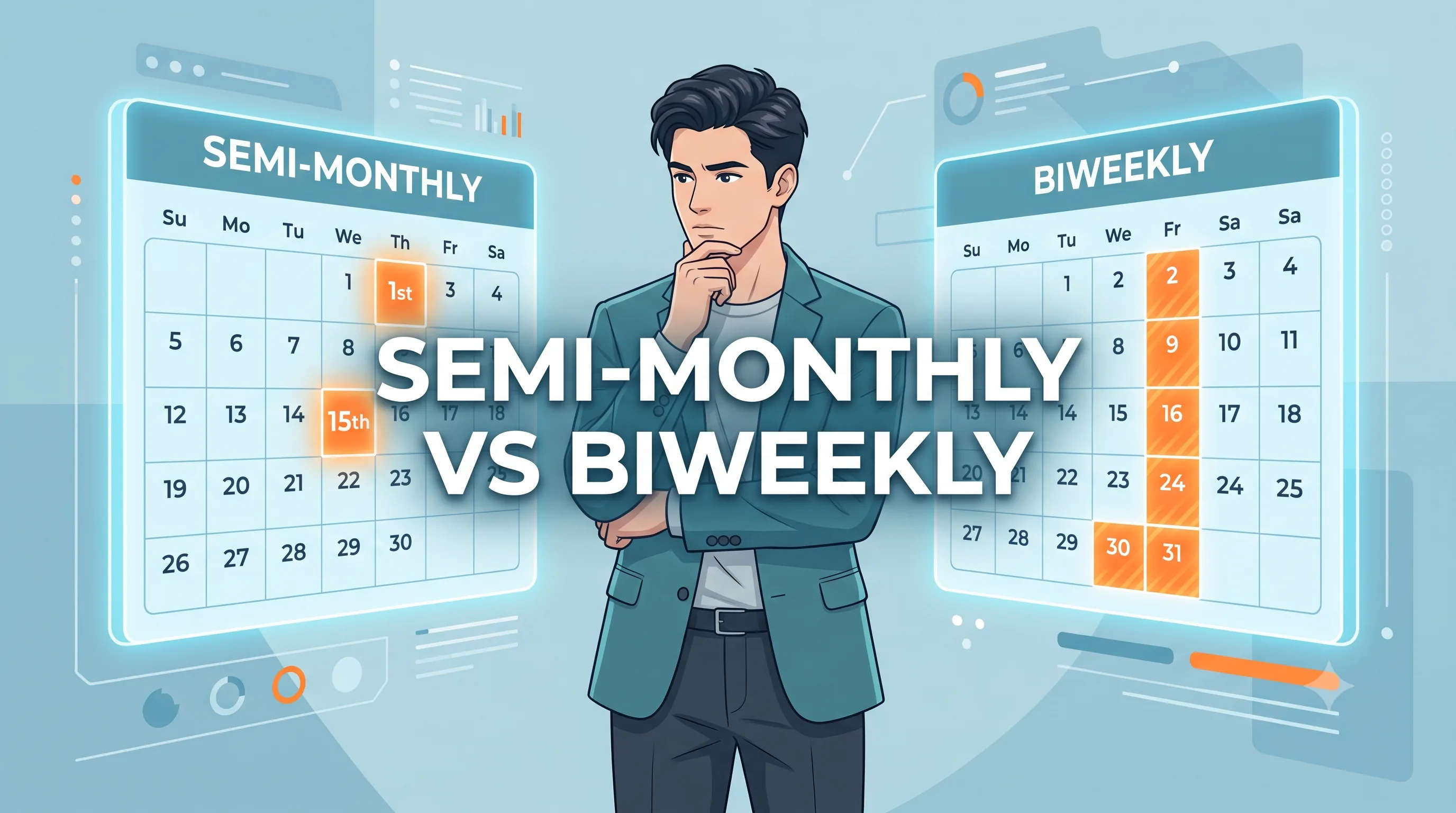
Have you ever stared at a job offer and gotten stuck on the pay schedule line? You're not the only one. One of the biggest points of confusion for new hires, and even small business owners running their first payroll, is the semi monthly vs biweekly pay debate.
They sound like they mean the same thing. You get paid a couple of times a month either way, right? Not quite. The schedule your employer picks changes how much money lands in your account each time, which exact days you get paid, and how you need to plan your budget around it.
- Biweekly pay: You get paid every two weeks on a set day, usually a Friday. That works out to 26 paychecks a year.
- Semi-monthly pay: You get paid twice a month on fixed calendar dates, like the 1st and 15th. That works out to 24 paychecks a year.
- Same total salary: Your annual pay doesn't change either way. The schedule only changes how it's split up.
- Overtime tracking: Biweekly lines up cleanly with a 7-day workweek, so hourly workers usually find it easier.
- Bill timing: Semi-monthly's fixed dates make it easier to plan around rent and other monthly bills.
Semi-Monthly vs Biweekly Pay: The Quick Answer
If you just need the bottom line, here's the exact difference between semi monthly and biweekly pay:
- Biweekly pay means you get a paycheck every two weeks on a specific day, like every other Friday. Because of how the calendar works, you get 26 checks a year.
- Semi-monthly pay means you get paid exactly twice a month on specific dates, like the 1st and the 15th. You get 24 checks a year.
That's the short version. But how does that two-check difference actually change your wallet and your bills? Let's break it down.
What Is Biweekly Pay?
Let's start with the most common setup in the US. What is biweekly pay in practical terms? It simply means you get paid every two weeks.
Most companies on this schedule pick Friday as payday. You get a check, wait two weeks, then get the next one. It's predictable. You always know payday lands at the end of the week, which is handy for weekend plans.
Here's the part people get curious about: how many paychecks in a biweekly setup do you actually walk away with in a year? The number is 26.
Why 26? A year has 52 weeks. Paid every two weeks means 52 divided by 2. Because most months run a little longer than exactly four weeks, those extra days add up over the year. That creates a quirk employees love: the "3-paycheck month."
Twice a year, because of how the weeks fall, you'll get three paychecks in a single month instead of two. If you're on a tight budget, those two months can feel like a small windfall.
What Is Semi-Monthly Pay?
Now let's flip to the other side. What is semi monthly pay, and why do so many businesses run it this way?
The semi monthly pay meaning is straightforward: you're paid exactly twice a month. Instead of picking a day of the week, like Friday, your employer picks specific calendar dates. Usually that's the 1st and the 15th. Sometimes it's the 15th and the 30th.
Because you get paid exactly twice for all 12 months of the year, the answer to how many paychecks in a semi monthly schedule is always 24.
Here's the catch with this setup: the dates never move, but the day of the week does. One month the 15th might land on a Friday. The next month it could be a random Tuesday. If payday falls on a Saturday or Sunday, most companies process it the Friday before, but it still makes your cash flow feel a little less predictable day to day.
Semi-Monthly vs Biweekly: Key Differences (Side by Side)
When you put biweekly vs semi monthly side by side, the real differences start to show. It's not just about when the deposit hits. It's about how your total salary gets sliced up.
| Feature | Biweekly Pay | Semi-Monthly Pay |
|---|---|---|
| Paychecks per year | 26 | 24 |
| Payday frequency | Every two weeks | Twice a month |
| Common paydays | Every other Friday | 1st and 15th (or 15th and 30th) |
| Paycheck size | Slightly smaller | Slightly larger |
| Overtime tracking | Easy, follows a normal 7-day week | Trickier for HR to split cleanly |
Let's talk about the biggest line on that table: paycheck size. Say you make a flat $60,000 a year. Paid biweekly, your gross paycheck before taxes is about $2,307. Paid semi-monthly, it's exactly $2,500.
Does Biweekly Pay More Than Semi-Monthly?
No, it doesn't, even though this myth comes up constantly. People search "does biweekly get paid more than semi monthly" all the time, and the answer is a flat no.
If your offer letter says $60,000 a year, you make $60,000 a year. The schedule doesn't change your total income by a single cent.
So why does the question keep coming up? It's an optical illusion. A biweekly schedule chops your $60,000 into 26 smaller pieces. A semi-monthly schedule chops it into 24 bigger pieces.
Because the biweekly chunks are a bit smaller, your regular monthly take-home can feel slightly lighter for 10 months of the year. Then those 3-paycheck months hit, and it feels like a bonus landed in your account. In reality, the math is just catching up to your full annual salary.
Semi-Monthly vs Biweekly: Pros and Cons
Every pay schedule has people who swear by it and people who can't stand it. Here's an honest look at both, no corporate fluff.
Biweekly Pros and Cons
The pros:
- The "extra" check: If you budget around two paychecks a month, that third paycheck twice a year is a nice bonus. Use it for a credit card payment, a vacation fund, or emergency savings.
- Total consistency: Knowing you get paid every other Friday takes the guesswork out of when your money lands.
- Easy overtime: Federal law tracks overtime on a 7-day workweek. Since a biweekly schedule is exactly 14 days, the math stays clean. If you track shifts with a Time Card Calculator, your hours match your paystub without a fight.
The cons:
- Budgeting shifts: Rent and mortgage are almost always due on the 1st. Since biweekly paydays move around the calendar, your check might land on the 3rd or 4th, meaning you need to hold cash from the prior month to cover early bills.
Semi-Monthly Pros and Cons
The pros:
- Predictable budgeting: If you're paid on the 15th and the 30th, you know exactly which check covers rent and which covers utilities. Spreadsheet budgeting gets a lot easier.
- Larger checks: Each paycheck is a bit bigger since your salary is split 24 ways instead of 26.
- Cheaper for employers: Running payroll costs money. Doing it 24 times a year is noticeably cheaper for a business than 26 times.
The cons:
- Shifting paydays: Getting paid on a Tuesday one month and a Thursday the next can be annoying if you like to handle errands and groceries on the weekend.
- Messy overtime: Since semi-monthly pay periods end on random calendar dates, a period can end mid-week. Splitting a week's overtime across two paychecks is a real headache for payroll teams.
Use our Semi-Monthly vs Biweekly Calculator to see exactly how your salary breaks down on each schedule.
Which Pay Schedule Is Better for You?
So, is biweekly better than semi monthly? There's no one-size-fits-all answer. It depends on your job and how your brain handles money.
If you're an hourly worker, especially one who picks up overtime often, biweekly is almost always the better setup. The math is cleaner, your paychecks reflect the exact hours you worked that week, and you don't wait an odd number of days for overtime money to process.
If you're a salaried employee who likes a strict, bill-aligned budget, semi-monthly works well. You never have to guess when your mortgage money is coming in, because your paycheck schedule mirrors your monthly billing cycle.
How to Budget on Each Pay Schedule
Budgeting is stressful enough without your pay schedule working against you. Here's how to make each one work for you.
If you're on a biweekly schedule: Base your entire monthly budget on just two paychecks. Map out rent, groceries, your car payment, and utilities using those two checks alone, and treat any extra money as if it doesn't exist yet.
Then, when those two 3-paycheck months arrive, you'll have a real chunk of free cash. Since you're not relying on it to get by, you can put it straight into savings, an index fund, or that lingering car loan.
If you're on a semi-monthly schedule: Your life revolves around the 1st and the 15th. Split your monthly bills into two lists. Put the big ones, like rent and your car payment, on the end-of-month paycheck. Put the flexible ones, like utilities, internet, and groceries, on the mid-month paycheck. Once that system is set up, your finances pretty much run on autopilot.
Frequently Asked Questions
What is the difference between semi-monthly and biweekly pay?
The main difference is frequency. Biweekly pay happens every two weeks on a specific day of the week, usually a Friday, which gives you 26 paychecks a year. Semi-monthly pay happens twice a month on specific calendar dates, like the 1st and 15th, which gives you 24 paychecks a year.
How many paychecks do you get with biweekly vs semi-monthly?
You get exactly 26 paychecks a year on a biweekly schedule. On a semi-monthly schedule, you get exactly 24 paychecks a year.
Does biweekly pay more than semi-monthly?
No, it doesn't. Your total annual salary stays exactly the same on both schedules. A biweekly schedule just splits your salary into 26 smaller paychecks, while a semi-monthly schedule splits it into 24 slightly larger ones.
Which is better, semi-monthly or biweekly?
Biweekly is generally preferred by hourly employees because it makes tracking weekly overtime simple. Semi-monthly is usually preferred by salaried employees because the fixed pay dates line up well with monthly bills like rent and utilities.
Is semi-monthly pay twice a month?
Yes. Semi-monthly literally means twice a month. Your employer picks two fixed dates, usually the 1st and 15th, or the 15th and the last day of the month, to run payroll.
The Bottom Line
Understanding semi monthly vs biweekly pay doesn't take a finance degree. It really just comes down to 24 checks versus 26.
Whether you like the predictable, bill-paying power of getting paid on the 15th and 30th, or you look forward to those 3-paycheck months on a biweekly cycle, knowing exactly how your money flows is the first step to running a real budget. Curious how your own salary breaks down on both schedules? Run your numbers on our Semi-Monthly vs Biweekly Calculator in seconds.