No Tax on Overtime in 2026: How Much of Your Overtime Is Actually Deductible?
 By
By 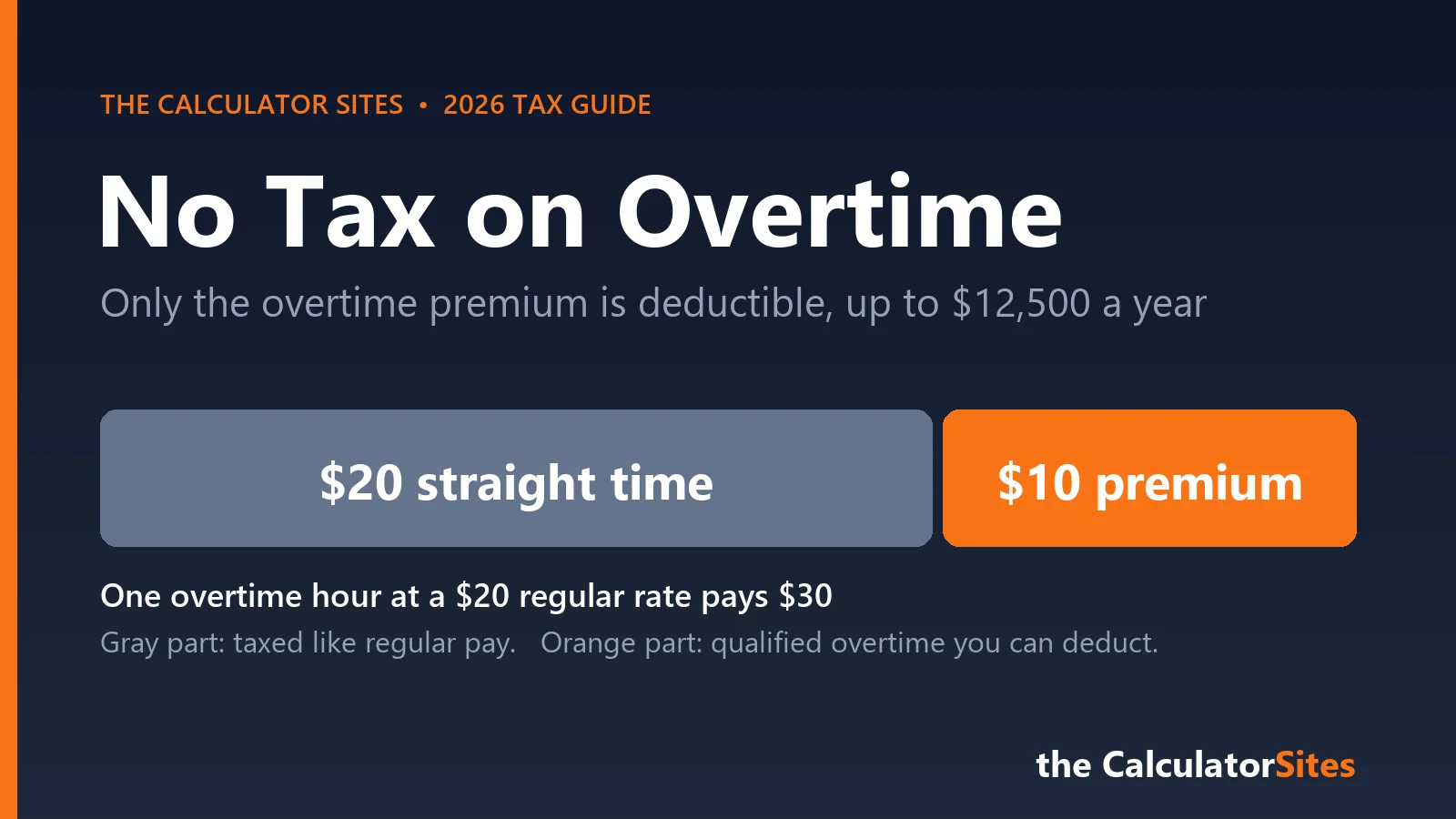
"No tax on overtime" does not make your overtime pay tax free. It is a federal deduction for the overtime premium, the extra half in time and a half. You can deduct up to $12,500 a year ($25,000 on a joint return) for tax years 2025 through 2028.
Social Security and Medicare still come out of every overtime hour, and only overtime required by the federal Fair Labor Standards Act counts. Below, I show exactly which part of your overtime qualifies and how to calculate your deduction. You will also see how much it can save, with real numbers.
- Only the premium counts: At $20 an hour, overtime pays $30, but only the $10 premium is deductible.
- Yearly cap: Up to $12,500 per return ($25,000 joint), reduced by $100 for every $1,000 of MAGI over $150,000 ($300,000 joint).
- FLSA overtime only: State daily overtime, union contract extras, and double time beyond 1.5x do not qualify.
- Payroll taxes unchanged: Social Security, Medicare, and withholding still apply; the savings show up on your tax return unless you update your W-4.
- Claim it on Schedule 1-A: From 2026, your W-2 shows the qualified amount in box 12 with code TT.
What Is the No Tax on Overtime Deduction?
No tax on overtime is a federal income tax deduction created by the One, Big, Beautiful Bill Act, signed on July 4, 2025. It lets eligible workers deduct the overtime premium they earn from their taxable income. In other words, you deduct the extra "half" in time and a half. The deduction applies to tax years 2025 through 2028 (IRS).
The name is a little misleading. Your overtime is not tax free. Your employer still withholds income tax, Social Security, and Medicare from every overtime hour, exactly as before. What changes is your tax return. When you file, you subtract the qualifying overtime premium from your income. As a result, you owe less federal income tax for the year.
Here are the main rules from the IRS, in plain English:
- Maximum deduction: $12,500 per year, or $25,000 if you are married and file a joint return.
- Income limit: the maximum shrinks once your modified adjusted gross income (MAGI) passes $150,000, or $300,000 for joint filers.
- Who can claim it: workers whose overtime is required by the Fair Labor Standards Act (FLSA), whether they itemize or take the standard deduction.
- Paperwork: a Social Security number valid for work on the return, and married couples must file jointly.
Which Part of Your Overtime Pay Is Deductible?
Only the premium is deductible, not your whole overtime check. The FLSA requires overtime of at least one and one-half times your regular rate for hours over 40 in a workweek (U.S. Department of Labor). So overtime pay has two parts: your regular rate for the hour (straight time) plus an extra half of that rate (the premium). Qualified overtime compensation is the IRS term for that extra half: the FLSA-required overtime pay "in excess of the regular rate" (IRS Q&A).
If you earn $20 an hour, your overtime rate is $30. Of that $30, the first $20 is ordinary pay and stays fully taxable. Only the $10 premium counts toward the deduction.
What About Double Time?
Double time does not double your deduction. The IRS gives this exact case in its August 2026 fact sheet. A worker earning $20 an hour works 50 hours. The employer pays double time for the 10 extra hours, or $400 of overtime pay. The FLSA only requires $300 (10 hours at $30), so the qualified amount is just the $100 premium. The extra $100 the employer chose to pay is ordinary taxable wages (IRS FS-2026-13).
How to Calculate Your Deduction (Step by Step)
You can estimate your deduction in four steps. Use the Overtime Pay Calculator to check the weekly numbers.
- Find your regular rate. Your regular rate is your total straight-time pay for the week divided by the hours you worked. For most hourly workers, that is simply the hourly wage. If you earn shift differentials or nondiscretionary bonuses, your FLSA regular rate is higher. Our Blended Overtime Rate Calculator shows how to work it out.
- Count your FLSA overtime hours. These are hours over 40 in a workweek. Hours over 8 in a day only count if they also push you past 40 for the week.
- Multiply. Regular rate x 0.5 x overtime hours = qualified overtime for that week. Add up every week of the year.
- Apply the limits. Cap the total at $12,500 ($25,000 joint), then reduce it if your income is over the phase-out threshold.
Example 1: Warehouse Worker at $25 an Hour
Maria earns $25 an hour and averages 5 overtime hours a week for 50 weeks, or 250 overtime hours a year. Her overtime premium is $12.50 an hour, so her qualified overtime is 250 x $12.50 = $3,125.
Her total pay is $50,000 of regular wages plus $9,375 of overtime ($37.50 x 250), for $59,375. As a single filer using the 2026 standard deduction of $16,100, her taxable income lands in the 12% bracket. The deduction lowers it by $3,125, which saves her about $375 in federal income tax for the year (3,125 x 12%).
Example 2: Nurse at $40 an Hour
James, a hospital nurse, earns $40 an hour and works 10 overtime hours a week for 50 weeks. His overtime premium is $20 an hour, so his qualified overtime is 500 x $20 = $10,000, which is under the $12,500 cap.
His pay is $80,000 regular plus $30,000 overtime ($60 x 500), or $110,000. After the standard deduction, his taxable income stays in the 22% bracket. So the $10,000 deduction saves him about $2,200.
| Worker (single filer) | Overtime Hours / Year | Qualified Overtime | Tax Bracket | Est. Federal Tax Saved |
|---|---|---|---|---|
| $18/hr, 3 OT hrs/week | 150 | $1,350 | 12% | $162 |
| $25/hr, 5 OT hrs/week | 250 | $3,125 | 12% | $375 |
| $40/hr, 10 OT hrs/week | 500 | $10,000 | 22% | $2,200 |
| $45/hr, 15 OT hrs/week | 750 | $16,875 (capped at $12,500) | 24% | $3,000 |
How these numbers were figured: each row uses the 2026 federal tax brackets and the $16,100 single standard deduction, the same figures used in our Take-Home Pay Calculator. Each example assumes 50 work weeks, 40 regular hours a week, single filing status, and no other income or deductions. Your savings depend on your full tax situation.
Enter your hourly rate and overtime hours to see your time and a half pay, then multiply the premium by your weeks of overtime.
The $12,500 Cap and the Income Phase-Out
The deduction is capped at $12,500 of qualified overtime per return, or $25,000 on a joint return. Because it only covers the premium, however, a single filer would need to earn more than $12,500 in overtime premiums before hitting the cap. At $25 an hour, that takes 1,000 overtime hours a year, about 20 a week.
Modified adjusted gross income (MAGI) is your adjusted gross income with a few foreign income exclusions added back. For most workers, it equals the AGI on Form 1040. If your MAGI is over $150,000 ($300,000 joint), the maximum is reduced by $100 for every $1,000 of income above the threshold. The IRS example: a single filer with MAGI of $165,000 is $15,000 over, so the $12,500 maximum drops by $1,500 to $11,000. At $275,000 of MAGI, a single filer's deduction is phased out completely.
Who Qualifies and Who Does Not
You qualify only if the FLSA requires your employer to pay you overtime. The IRS is explicit on this point. Overtime paid because of a union contract, a state law, or an employer's own policy does not count unless the FLSA also requires it (IRS FS-2026-13).
| Situation | Counts? |
|---|---|
| Hourly employee, time and a half for hours over 40 a week | Yes, the 0.5x premium |
| Salaried but non-exempt employee paid FLSA overtime | Yes, the 0.5x premium |
| Double time paid by the employer for hours over 40 | Only the 0.5x the FLSA requires |
| California daily overtime for hours over 8 in a 40-hour week | No (state law, not FLSA) |
| Weekend or holiday premium within a 40-hour week | No |
| Exempt salaried employee (manager, professional) paid extra for long hours | No |
| Business owner with a 20% or larger stake who manages the business | No (treated as exempt) |
Not sure if you are exempt? A salaried title alone does not make you exempt. Under the FLSA, an exempt employee must pass a duties test and generally earn at least $684 a week on a salary basis (DOL Fact Sheet #17A). Our guide inside the Salary to Hourly Calculator explains how to compare a salaried job with an hourly one.
Does This Make Your Paycheck Bigger?
Not automatically. The IRS says employers must keep withholding federal income tax on all overtime. However, they may not reduce it for the deduction unless you give them a new Form W-4. The 2026 W-4 added a line in Step 4(b) for your expected overtime deduction. Entering it lowers your withholding during the year (IRS FS-2026-13).
If you leave your W-4 alone, you will usually get the benefit as a bigger refund or a smaller tax bill when you file. Social Security and Medicare are not affected, so those amounts on your pay stub stay the same either way. To see how your take-home pay changes when your withholding changes, try the Take-Home Pay Calculator.
How to Claim the Deduction on Your Tax Return
- Check your W-2. Starting with tax year 2026, employers must report qualified overtime in box 12 with code TT. Some payers report it on a Form 1099 instead. In that case, look in box 1d of Form 1099-NEC or box 14 of Form 1099-MISC.
- Fill out Schedule 1-A with your Form 1040. This is the IRS schedule for the new deductions on tips, overtime, car loan interest, and seniors.
- Add your Social Security number and, if you are married, file a joint return. Married filing separately cannot claim it.
- Keep your pay stubs. They show your overtime hours and rates if you ever need to confirm the amount.
For 2025 returns, employers did not have to report the amount separately. So many workers estimated it from pay stubs, using the IRS methods in Notice 2025-69. From 2026 on, the W-2 does most of the work for you.
Common Mistakes to Avoid
- Deducting your whole overtime check. Only the premium counts. At $20 an hour, deducting the full $30 overtime rate instead of the $10 premium would triple the deduction you are allowed.
- Counting state or union overtime. Daily overtime, weekend premiums, and contract double time beyond the FLSA requirement are not qualified.
- Forgetting your regular rate includes differentials. Night or weekend differentials raise your FLSA regular rate, which raises your premium too. The Shift Differential Calculator shows the effect.
- Expecting lower Social Security or Medicare. The deduction only reduces federal income tax.
- Assuming your state follows it. This is a federal deduction. Whether your state income tax allows it depends on your state's own law, so check your state revenue department.
Working rotating 12-hour shifts? Your overtime can swing a lot from week to week. The Shift Schedule Pay Calculator estimates your average weekly overtime on a 2-2-3, 4 on 4 off, or DuPont schedule. From there, the yearly premium is easy to estimate.
Frequently Asked Questions
Is overtime tax free in 2026?
No. Overtime is still taxable wages, and income tax, Social Security, and Medicare are withheld as usual. However, the new rule gives you a deduction when you file. You can subtract the FLSA overtime premium (the extra half in time and a half) from taxable income, up to $12,500 a year.
How much is the no tax on overtime deduction worth?
It depends on your premium pay and tax bracket. For example, a worker earning $25 an hour with 5 overtime hours a week for 50 weeks has $3,125 of qualified overtime. That saves about $375 in the 12% bracket. A $40-an-hour nurse with 10 overtime hours a week could save about $2,200.
Does double time count for the overtime deduction?
Only partly. The deduction covers the premium the FLSA requires, which is half your regular rate for hours over 40 in a week. If your employer pays double time, the extra amount above time and a half is ordinary taxable pay and does not count.
Do salaried employees qualify for no tax on overtime?
Only if they are non-exempt under the FLSA and are paid required overtime. Exempt salaried employees do not qualify, even if they are paid extra for long hours. That includes most managers and professionals who meet the duties and salary tests.
Does California daily overtime qualify for the deduction?
Not by itself. Some overtime is paid only because of state law, such as hours over 8 in a day during a week under 40 hours. The FLSA does not require that pay, so it is not qualified overtime compensation.
Will my paycheck get bigger because of the overtime deduction?
Not automatically. Employers keep withholding income tax on overtime unless you file a new Form W-4. The 2026 W-4 lets you enter the expected deduction in Step 4(b). Otherwise, you get the benefit as a larger refund or smaller balance due.
How do I claim the no tax on overtime deduction?
Use Schedule 1-A with your Form 1040. For 2026 and later, your employer reports qualified overtime on your W-2 in box 12 with code TT. You need a Social Security number valid for work, and married couples must file jointly.
How long does the no tax on overtime deduction last?
Under current law, it applies to tax years 2025 through 2028. Unless Congress extends it, it ends after the 2028 tax year.
The Bottom Line
No tax on overtime is a real tax break, but it is smaller and narrower than the name suggests. You deduct only the FLSA overtime premium, up to $12,500, and you still pay Social Security and Medicare on every hour. For a typical hourly worker, that means a few hundred to a couple of thousand dollars back at tax time. So check that your hours over 40 are counted correctly and look for code TT on your 2026 W-2. If you would rather have the money in each paycheck than in a refund, update your W-4.
Editorial standards: our guides cite primary sources such as the IRS, the U.S. Department of Labor, and the BLS, and we update them when the rules change. Read more about the author, or contact us if you spot an error. This guide is for education only and is not financial, tax, or legal advice; see our disclaimer.