You're Working 2 Months a Year Just to Pay Interest (Here's the Math)
 By
By 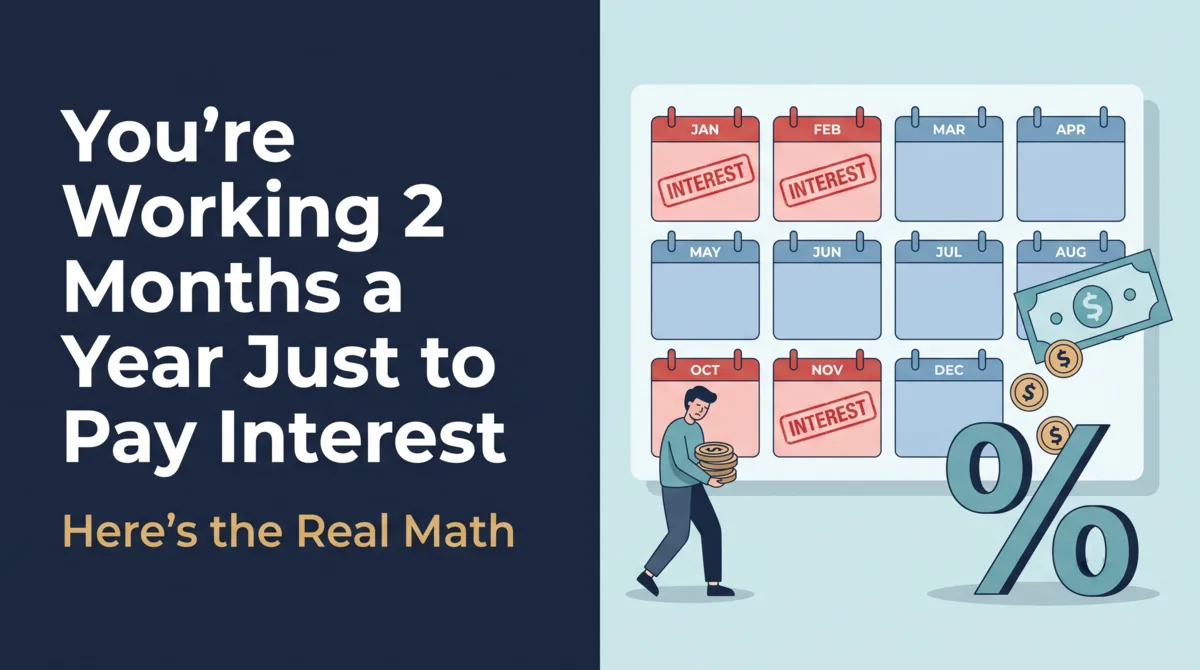
Let's talk about something most of us try to ignore every time we log into our bank accounts.
Every single month, a huge chunk of your hard-earned money leaves your account to pay your credit cards, car loans, and student debt. But here's the gut-punch: a massive percentage of that payment doesn't even lower your balance. It just vanishes into thin air, straight to the bank as an interest payment.
We're taught to view interest as just a financial fee. But we need a massive reframe here. That interest isn't just money. It's your time. You literally squander weeks, and sometimes months, of your life working 40 hours a week, just so you can hand that money over to the bank and earn the privilege of being in their debt.
If you feel like you can't get ahead, it's not because you aren't working hard enough. It's because you're working just to pay interest.
- Interest is time, not just money: Every dollar you pay in interest is a fraction of an hour you spent working.
- It adds up fast: The average person spends a shocking share of their income just servicing debt.
- You can calculate your own number: Divide your annual interest paid by your hourly wage to find exactly how many weeks of your life go to debt each year.
- For many, it's brutal: That number often works out to over 8 weeks, roughly 2 full months of work every year, just for interest.
What Interest Really Costs You (It's Not Money, It's Time)
If you've ever read Vicki Robin's classic book Your Money or Your Life, you know the concept of "life energy." Money isn't just paper or numbers on a screen. Money is the physical life energy you trade to get it.
When you look at debt through this lens, the real cost of debt becomes terrifying.
When you pay down the principal on a loan, you're buying your freedom. You're lowering the amount you owe. But when you pay interest, you're getting absolutely nothing in return. It buys you zero groceries, zero vacations, and zero peace of mind. It's simply a penalty fee that keeps you trapped on the hamster wheel.
Think about your daily commute, the meetings you sit through, and the stress of your job. The time cost of debt means you're doing all of that just to keep the bank happy, while your own net worth stays exactly the same.
How Much of the Average Paycheck Goes to Debt and Interest?
If you feel like your paycheck vanishes the second it hits your checking account, the data backs you up.
Exactly how much of your paycheck goes to debt? According to Northwestern Mutual, the average American carrying debt uses roughly 30% of their monthly income just to cover non-mortgage debt payments.
If you look at the broader picture, the Federal Reserve puts the national debt-service ratio at about 11.32%. That means over 11% of the country's disposable income is tied up in mandatory debt payments.
And that's just the minimum payments. When it comes to pure interest, a 2025 WalletHub study showed that the average person paid around $396 a year in credit card interest alone. If you have a car loan, student loans, or carry a larger-than-average credit card balance, that number skyrockets.
The Real Cost of Debt: What Americans Pay in Interest
The banks are making a fortune off of our "normal" spending habits. Just look at the numbers.
In 2025, Americans paid a mind-blowing $253 billion in credit card interest alone, according to WalletHub. By early 2026, the Federal Reserve reported the average credit card APR for accounts carrying a balance hit an absurd 22.15%.
So, how much interest does the average person pay over their entire life? According to estimates from Self.inc, the average American will pay roughly $649,067 in total interest over their lifetime, including mortgages, cars, and credit cards.
Take a second to process that. Over half a million dollars of your lifetime earnings, gone.
How to Calculate Your Own "Interest Work-Time"
You can look at national averages all day, but nothing will motivate you to get out of debt faster than running your own numbers.
People always wonder, "how many hours do I work to pay off debt?" Here's the exact formula to find out:
- Add up all the interest you paid last year. Check your credit card statements, auto loan statements, and personal loans. Only count the interest, not the principal.
- Find your hourly wage after taxes. If you're salaried, take your take-home pay and divide it by 2,080 hours.
- Divide your total annual interest by your hourly wage.
Let's do a real-world example. The median hourly wage in the US is roughly $25.67. Say between a heavy credit card balance, an auto loan, and a personal loan, you're paying $8,000 a year purely in interest.
$8,000 ÷ $25.67 = 311 hours
If you work a standard 40-hour week, 311 hours equals almost 8 full weeks of work. That means you're working 2 months out of the year just to pay the bank. January and February? You worked those months for free. You didn't get to keep a dime of that life energy.
Use our Debt Payoff Calculator to see exactly how much sooner you'll be debt-free with extra monthly payments.
Is It Normal to Pay This Much Interest?
When you do that math, it feels terrible. It prompts a very valid question: is it normal to pay this much interest?
Sadly, yes. It's completely normal. Roughly 46% of credit card holders carry a balance from month to month, and nearly half of them believe that carrying debt is just a normal part of life.
But here's the harsh truth: in today's economy, "normal" means living paycheck to paycheck. Normal means being broke. Just because everyone around you is trading their life energy to Visa and Mastercard doesn't mean it's unavoidable.
Where Your Money Actually Goes (Interest vs Principal)
If you're currently paying off a car or making minimum payments on a credit card, you might be asking, "how much of my payment goes to interest vs principal?"
The system is designed to keep you paying interest for as long as possible. For installment loans like a car or a mortgage, the loans are "front-loaded." In the first few years of the loan, the vast majority of your monthly payment goes straight to interest, and only a tiny sliver goes toward the principal.
For credit cards, it's even worse. If you have a high APR and only make the minimum payment, you're barely treading water. If your minimum payment is $100, it's very possible that $90 of that is going to interest, and only $10 is reducing your actual debt.
How to Stop Working Just to Pay Interest
Once you realize that interest is stealing your time, the only logical question left is, "how do I stop wasting money on interest?"
You have to change your strategy immediately. Every extra dollar you throw at your debt is literally buying back hours of your future life. Here's how you do it:
- Stop paying the minimums: The minimum payment is a trap designed to keep you in debt for decades. Pay literally anything above the minimum.
- Use the Avalanche Method: List all your debts. Find the one with the highest interest rate, usually a credit card. Throw all your extra cash at that specific debt while paying the minimums on everything else. Mathematically, this saves you the most time and money.
- Look into balance transfers: If you have a good credit score, transfer your high-interest credit card debt to a 0% APR balance transfer card. This gives you 12 to 18 months where your entire payment goes toward the principal amount.
Every time you wipe out a debt, you aren't just saving money. You're taking back the months of your life you used to work for free. Use our Debt Payoff Calculator to see exactly how much time you can save by paying just $50 extra a month.
Frequently Asked Questions
How much interest does the average person pay per year?
While it varies wildly based on mortgages and auto loans, the average American paid roughly $396 per year purely on credit card interest in 2025, according to WalletHub. Factor in car loans, personal loans, and mortgages, and that number can easily jump into the thousands annually.
How do I calculate how many hours I work to pay interest?
Take the total amount of interest you pay in a year across all your debts and divide it by your post-tax hourly wage. The result is the exact number of hours you worked that year just to hand money to the bank.
Is it normal for so much of my payment to go to interest?
Yes, especially in the early years of a loan or when making minimum payments on credit cards. Lenders front-load interest on installment loans, meaning the bank gets its profit first before you make real progress on your principal balance.
How can I reduce the interest I pay?
The easiest way is to pay more than the minimum amount each month. You can also use the debt avalanche method (paying off the highest interest rate first), refinance a high-cost auto loan, or use a 0% balance transfer card while you pay down the principal.
How much of my income should go to debt?
Financial experts generally recommend the 20% rule: no more than 20% of your net salary should go toward debts other than your home loan, such as credit cards, student loans, and car payments. Check your own ratio with our Debt-to-Income Calculator. Paying more than that is a sign it's time to revisit your budget.
The Bottom Line
Debt has been normalized to the point that we don't even think about it anymore. But the next time you hit "submit" on your credit card payment, remember what that money represents.
Your time is your most valuable asset. It's finite, and you can never get it back. The real cost of debt isn't a percentage rate. It's the weeks and months you spend sitting at a desk, working just to pay interest.
But there's hope. Every extra payment you make, every time you choose to aggressively attack your principal balance, you're buying back your freedom. Stop working for the bank, and start working for yourself.